Monday, November 05, 2007

ReedNews Update- November Edition

Weather—Warmer and very humid, with daytime temps in the upper 80’sF, mid 70’sF during the night. Rain almost every night, sometimes heavy, but little or no rain during daylight hours. Hazy, partly cloudy skies. Light breezes, mostly from the East.
UPDATED Friday November 9
Time continues its inexorable march to wherever it is going, and as it marches, some things change and some things stay the same. We’re here to tell you which is which in our corner of Liberia, West Africa.

--Changes: President Ellen Johnson Sirleaf was in the US last week getting a Medal of Freedom from pal George W. This is further evidence of Sirleaf’s standing around the world, but back home we continue to wait for the oft promised improvement to water, power, transportation and health infrastructure. We are reading in the papers that major demolition of roadside houses, followed by major road construction will begin any day now. Meanwhile, the potholes are getting deeper. Interestingly, the one thing that has already been completed refurbished is the 50,000 seat Samuel K. Doe football stadium.

--Changes: The tomatoes have arrived! Monrovia is stocked again with Romas, although we are still getting gouged a bit—about three small Romas for over a US dollar and a half. My sandwiches are whole again.

--Changes: Next door, Patience, the 18 year old granddaughter of the late Deacon Reeves, delivered a baby girl. Renita was closely involved in the labor and delivery process, and has since been getting her “baby fix” by stealing the lil’ dumpling for hours on end. The baby’s name is… Renita. This is the fourth kid that has been named for my dear wife, while I on the other hand, am batting zero in the “named after me” department. Yes I’m jealous. I keep telling myself it’s because her name is so unusual and mine is so common. But the truth is my wife is a honkin’ saint, and me, well, I’m something else. She, they love. Me, they laugh at.

--Changes: The Foster Town Market is accepting applications for a superintendant. The truth is the market has been suffering under the effects of “management by committee,” and needs a paid point person to do the job. In addition, there remains a small group of very disruptive women who are doing what they can to sand bag the whole operation. They never accepted the fact that they were not placed in charge to run the operation from the beginning, and are now actively engaging traditional magic women to cast curses on everybody involved. It’s a real spiritual battle, but the faithful women of the market are holding prayer vigils and some of the disruptive ladies have actually repented and begged forgiveness. It’s going to be all right.

--Changes: The little piggy we received from the Kataka farm in the spring is now a hundred fifty pound hog and growing. We are planning a community pig roast the end of the month. This of course means the hog will get killed and butchered right here. Many of our Liberian friends are clamoring to do the deed. We’ll let you know what happens.

--Changes: Speaking of the Kakata farm, we took a trip last Saturday to see how the rice planted over the last few months is doing. (See April 2007 Archives, "Kakata" post for a "before" view.) The farm, co-owned by our friend and local pastor Augustine Zar, is one of the places some of you are supporting through your contributions our “community development fund.” Because of these gifts and the hard work of this large extended family, they will not only have food to sustain themselves, but they are employing a number of farm hands and they will be providing rice, eggplant, pepper and cassava to local markets. On the path to the fields, we passed about arm's length from a four foot long cobra in the bushes, about chest high. It slithered off before the boys could get to it with their machetes.


--Same: Nikki, our two year old female mutt turned actress, was not pregnant. We think the introduction of a male dog into the yard got her hormonal juices flowing. She produced milk for two weeks and actually appeared to be growing. Noah, a hopeful believer to the last, finally admitted the truth the rest of us had accepted when he realized we were three weeks past the gestation period for a dog. We believe she will become “available” sometime after the new year, and we’ll see what Max and she can produce together.

--Same: The humidity is wrecking more things (dvd player, padlocks), and I’m dripping.

On a trip through the city before heading out to the Kakata farm. Monrovia's main road by the end of the rainy season. We keep our fingers crossed for the promised rebuilding.

Our way along the path to the rice. This was taken just after our encounter with the cobra; you can see how easily the creatures can find places to hide.

We break out of the brush and we get a panorama of the rice fields.

Renita and Rev Zar discussing the progress and process of farming rice. The rice n the far left is ready for harvest.

Yers Trooly Grokking the Groovy Glory of Green.

This is what happens when we leave for the farm. "Are they gone? Can we come in now?"

Monday, October 29, 2007

The Impossible Task of Liberian Counselors

Weather: Humid, with nightime rains. Occasionally heavy, with local flooding. Daytimes are mostly partly cloudy, humid with little rain. Temps in the upper 80s during the day, the upper 70s at night. Light and variable breezes, mostly from the East.

I tend to gush when I talk about Liberians engaged in providing psychosocial support to fellow Liberians. Working in the minds and souls of people is the type of work I’ve been doing for twenty five years, so I know something about how difficult it is. For Liberians engaged in counseling their countrymen and women, the work needing to be done is usually incredibly challenging, and sometimes cannot be done at all.

I am not one given to overstatement or hyperbole, but it is difficult to discuss Liberia without sounding like I am exaggerating. The plain facts sound like overstatement. Fourteen years of civil war. 20,000 child fighters. One in ten dead, one in three displaced. Tens of thousands raped. Thousands tortured. A failed state. Education, transportation, and health Infrastructure destroyed. Rampant poverty and crime. Almost every Liberian above the age of fifteen has a story to tell of terror and victimization.

The facts regarding the psychosocial response to the Liberian Crisis sound equally melodramatic. The typical Liberian counselor has had little or no professional training. International NGOs like the UNICEF or USAID have provided some help, but their training workshops last at most a few months and offer the most rudimentary and fundamental counseling principles and techniques. Most of the time, ongoing support and supervision is not included in the training package. Follow up is rare.

Many professional counselors, including myself, have argued that the majority of counselors working in this country are not qualified for the task. We have argued that most Liberians in this field should not be providing counseling at all, let alone working with people suffering the effects of severe trauma. Many professionals have suggested some of these counselors are doing more harm than good. They are probably right.

However these arguments are moot. Very few qualified mental health professionals—and particularly the vocal critics— seem to have any alternatives to offer, and fewer still are in Liberia themselves doing any work. The people who are here doing the work are the “unqualified Liberians.”

It is because of these plain facts that I find myself in awe of the work Liberian counselors are doing. These are men and women with inadequate support and training, getting paid next to nothing, in the field listening to everyday stories from fellow Liberians— including many stories that would make most of us ill. Some do not know their limits, some offer bad advice, some make it worse. But they are all there-- in the midst of the sadness and confusion and loss and horror of their Liberian countrymen-- because no one else is, and somebody has to do something. They stand in the gap in order to help heal others—often an impossible task given the damage they face and the limitations of their training—in part because no one else will. Humanitarian observers and mental health professionals owe Liberian counselors more than criticism for being unqualified, we owe them more than disdain for sometimes working beyond their skill level.

At Mother Patern College, we are the first to offer a professional training program that will provide counselors with more tools than they have ever had to address the colossal psychosocial needs of Liberia. But we will only be graduating a couple dozen Social Workers every year, and that not until 2011.


In the meantime the best we can do, the best I can do, is to work as close as I can to as many counselors as I can to provide support, ongoing training and supervision as they work with their overwhelming case load. In the meantime, we continue to try to build the skills of those standing in the gap.

For the past two weeks, I offered a fifty hour seminar to eleven Liberians who every day hear the stories, who every day sit with people and offer hope. They were from several organizations—a health and development group for women, an HIV-AIDS program, a women’s legal advocate, a counseling agency, the Catholic Church. It was a privilege and a learning experience for me as well, and a lot of fun to boot. I hope we can continue to work together. After all, the task is impossible, and really, none of us are qualified to do it by ourselves. Impossible tasks ought to be shared. As always, you’re invited to join in the fun.


Yers Trooly in front of some Liberian Heroes as we open another workshop day.

Many exercises. Here, we sit back to back to see if we can get the message of our partner without using non verbal cues.

Some face to face practical counseling exercises.

Counseling is not something you can learn from lecture. You have to do it. Sister Thava, on the left, practices counseling Wannie Mae.
The last day-- class picture time. Ten Liberians, one Sri Lankan, and a privileged facilitator from Michigan, USA.

Monday, October 22, 2007

Tomato Jonesin’


I’ve been dyin’ over here. Tomatoes, man. I got it bad. And there are none in the city. You got that? A city of over a million, and its out of tomatoes. None in any of the large Western style super markets, none in the local Liberian open air markets, none on the street. And hey, I need tomatoes. They are necessary for my sense of culinary wholeness.

See, I’m a sandwich guy. I love them. Easy to make, sandwiches are a complete and balanced meal in one hand. You got your grains in the bread, you got your meat for protein, you got your dairy with cheese, and you got your vegetables—onions or cucumber maybe. But what is a sandwich without a cool slice o’ tomato? It’s a honkin’ disappointment, that’s what it is, a letdown. A sandwich without tomato is a promise unfulfilled, a dream unrealized. And in Liberia, a sandwich made right—with tomato—tastes like home to me.

Ok, so for almost two months, the Capital city of Liberia has been sans tomato. Tomatoes do not grow well here, so they have to be shipped in. Usually whoever does the shipping keeps the city stocked with a steady supply. It’s the same for all Western produce. Apples, pears, carrots, good onions all get shipped in, so when they are gone, they’re gone for everybody all at once. Some produce, like apples and tomatoes, are more abundant than others. We see good lettuce maybe twice a year. Plums the same. I can’t remember ever seeing a peach. But right now, Monrovia seems out of everything.

We’ve seen two or three week dry spells before for but this is ridiculous. Until today, I hadn’t seen a tomato since early September. And I’ve been looking. In fact for over a week I’ve been driving in every day because I’m conducting this two week seminar for Liberia’s counselors (which I’ll tell you about later.) Not only that, but because the government is working on the pothole-filled roads in town, it takes me an hour and a half to drive the twelve miles. So I get a long look at all the markets along the way.

Today I got lucky. Driving in, as I broke through a traffic jam, I glanced to my right at a little produce stand we often visit. Like everywhere else, the produce was green or yellow: grapefruit, pineapples, bananas, papayas, or butter pears (avocado). Same old thing. And then I saw a hint of red in a box. I thought: “Is it? Could it be? It is!” It was a box of tomatoes. But I couldn’t stop. Traffic was too heavy and I was already past. I felt panic. “Where did they get them? Why do none of the other markets have them? The only tomatoes in town, and I just passed them! How long can they possibly last?” During our lunch break, I needed to rush to the bank which took me back past the same stand. Again I was unable to stop because I had to get back to the workshop. The tomatoes were still there, but the box was half empty. Other tomato junkies were beating me to the goods. Probably some were hogging more than their fair share. Not good.

By the time the workshop ended for the day, I knew only one purpose. After answering a few post workshop questions from the participants, I excused myself and bolted to the Cruiser. The traffic was a bit lighter, although the potholes were just as treacherous. After a few jolting minutes, I could make out the market. And even from down the road, I could still see the glorious red glint of ripe Romas beckoning me hither. I pulled into the parking area, jumped out of the Cruiser, and there she was: the Tomato Lady. She was charging premium prices for her stash, but in my state, I would have given her my wallet. I bought nine Romas for $5.00, and I should have bought more. I know I may not see them again for a while.

This afternoon, I had an egg salad and tomato sandwich. Later, I’ll snack on a cheese, potato green and tomato—or maybe just tomato and mayo. For breakfast, maybe a grilled cheese and salami sandwich—with tomato. The Romas might make it to Tuesday night, but they might not. Until then, I’m good.

I’ll worry about Wednesday Wednesday.

Monday, October 15, 2007

Slip Slidin' Past Bong Mines

Weather: Very heavy rains the past few days, with over a foot since Thursday. Some strong storms. Mostly cloudy skies in the morning, clearing to partly cloudy by afternoon. Dew points in the upper 70’s. Hi Temps in the mid 80’s, lo temps in the mid 70’s. Variable and shifting breezes.

After some discussion, we decided Renita would try the trip to a banana and corn farm past the Bong Mines area with the LEAD staff, and that I would mind the fort back home. I originally thought I'd drive but I think this was in part due to some cave man part of me that thought maybe "I oughta take the wheel, honey." We both decided to let that go.

LEAD is looking at some farms for investment opportunities. The area where this farm is lies roughly sixty miles north of Monrovia. We were told the roads were good. Listening ‘twas a mistake that shan't be repeated.

It took Renita over five hours over terrible-- and intimidating--roads to make it there, and of course five hours to get back. The Land Cruiser got stuck briefly four times, and she was exhausted by the time she made it to her family that night, but she proved what a great bush driver she is. Here is what it looked like last Thursday, although the pictures fail to capture the extent of the treachery of these roads.


On the way out-- even the big fellas fall victim to the deep muck.

The roads are deceptive. The mud is part clay, and very sticky and slippery. Another semi "heech."
This was once a vital iron ore mining town.
Off the big bad road, now onto the two track bad road.

In some places, the forest almost swallows the road.

Here, Renita got stuck for a few minutes. We're still trying to figure out wha' happened.


The Team finally made it to the farm. Consulting with the folks tending the plantains.

For a few Liberians, a Field of Dreams.

On the way back, the LEAD guys attempt to offer muck-avoidance counseling.

It didn't work. Renita "heesh da jee' on da stum'." Some body damage, but after a half hour, some friends and a machete (here called a cutlass), she was back in business.
Hurry lady! It's gettin' dark, and this road ain't any nicer at night!

Monday, October 08, 2007

Ebb Today, Flow Tommorrow

Weather: Mostly sunny and hot during the day, with thundershowers during the night. Locally heavy rains for brief periods. Highs during the past few days in the upper 80s, lows in the upper 70’s. Today (Monday the 8th) begins very bright, and should be sunny most of the day. Nice breeze out of the east, 10-15mph.

We’ve had a bit of a breather these last few days, which has been nice. More time to sit in the yard at day’s end, more time to visit with some of our community and church friends. As the rainy season transitions into the dry, we are afforded lovely sunsets and in the evening, refreshing off shore breezes.

But it’s a brief respite. Beginning late this week, we enter a few weeks of intense activity. Renita’s work with LEAD will have her—and the rest of the Reeds-- traveling deep into the interior to Lofa County. Lofa is NNW of us, on the Guinea/Sierra Leone borders. Because of the road conditions, even though our destination is less than 150 miles away, we will take all day to get there and have to spend the night. Renita is traveling to Lofa, and also to a place called Bong Mines in Bong County, to evaluate two agricultural projects that LEAD is considering as investment prospects. The Lofa project is a coffee plantation, the Bong Mines project is growing bananas and corn. The Reeds just purchased a well maintained 2000 Toyota Land Cruiser from Mother Patern College, so we’ll see what she can do in the Liberian bush. We would never attempt these journeys with the old Pathfinder, which we are hanging onto for backup. Anyway we should have some great pictures for you of a very different Liberia upon our return.

I will also be revving up. In addition to acting as driver and comic relief for the two LEAD trips, starting October 15 I will be conducting a sixty hour seminar on counseling skills for a group of Liberian counselors from several organizations. Basically, I get to be in front of the class for two weeks, Monday-Friday, from 8:30am to 3:30pm. It’s a gauntlet, but I am looking forward to it. I find I enjoy talking about the craft, especially with those who are practicing but know they need more training. I get to impart my know-how and tricks of the trade while they get to share their experience of field work in this deeply challenging culture. Hopefully, everybody will leave enriched and more connected with each other for future support.

Around town, some road work is beginning. For a couple weeks now, it has taken us up to an hour and a half to get into or out of town as the government works on building up secondary roads to act as bye-passes for the really big job just around the corner. They will be resurfacing the main road through Monrovia, out right past our house all the way to the airport, thirty miles from here (forty five miles from downtown Monrovia), then beyond the airport all the way to Buchanan, some eighty miles away. Obviously, even with an army of equipment, I don’t think this can be done in one dry season, but I think they’ll get a good portion of it done. Unfortunately, this will mean demolishing homes, schools, and businesses that have built too close to the road. Some of our friends will see their homes and business structures vanish before the wrecking ball. We’ll keep you informed.

A bit o' the morning routine. Homeschool includes P.E.. Here, Noah tosses a perfect spiral to Hannah during real football practice.Meanwhile, the Pathfinder's fuel lines are corroded and pouring gas. The mechanics from Mother Patern come to do what they do best. That's Mohammed in the wheel well, lead mechanic Mohammed observing, and MPCHS driver Matthew keeping company.

More of Renita sharing toothy tidbits. "Use your Brain more than your Back." Amen.

Last night, facing due NE, sittin' in the yard with the sun setting at our left shoulder, lighting up the papaya tree on the left with the new Land Cruiser on the right. In the background a storm is a'comin'.

Monday, October 01, 2007

Liberian English

Liberia is classified as an “Anglophone” country. Despite its 15 active tribal languages, the official language of the country is English. This makes it easier for us to work here, obviously because we did not have to learn a completely new language upon arrival. I said it makes it easier, but understanding the Liberian version of English is not always easy, and even after two years sometimes it is impossible. Being the amateur linguist that I am, I’ve been able figure out what is behind this difficulty in understanding my native tongue when uttered by many Liberians. It is not simply a matter of accent.

First, and most obvious to the listener, is in the way Liberians pronounce many words—the end of many words are left off. “House” becomes “haw”, “dog” becomes “daw”, “serious” becomes “seria”, and so on. Sometimes even each syllable in multi syllable words are deleted, so “redlight” might become “re’li’”, “everything” is “e’ry’tin’, or ” kool aid” is “koo aye.”

To complicate matters significantly, Liberians use different English words than most North Americans choose. For example, “reaching” means “leaving” as in “I’m reaching to my hou’,” “finish” means “to be out of something,” As in “the rice is finish,” or “flog” instead of “beat,” as in “My brother tol’ me he wou’ flog me.” Finally, Liberians finish many words randomly in “O,” as in “fini-o” for “finish,” or “daw-o” to give “dog” a little more panache.

Therefore when you combine words pronounced differently with word choices that are different than what you’ve lived with all your life, you get sentences that are just a little beyond reach until you understand both the usage of the word and the pronunciation of all the words in the sentence.

So, putting these factors together, we might have the following sentences—see if you can figure them out:

1. “Trokon carry mah own sef pla’ toe to hi’ hou’.’” (Literally, “Trokon carry my own self play toy to his house,” or “Trokon took my toy to his house.”)

2. “Dea’ ca’ be sweeo.” (Literally,” Deer can be sweet-o,” or “Venison is delicious.” )

3. Leh ca’ta’ eh sleepi’ bah da’ pi’ hou’ (Literally, “the carter it sleeping by the pig house” or “The carter (a clothe pad used to cushion the head when carry things) was left out all night near the pig pen.”)

4. “De ro’ he wah a bri’ one and dryo.” (Literally, “The rogue he was a bright one and dry-o,” or “The thief was light-skinned and very thin.”)

5. “Leh pum’ eh spoi’. Le’ carry de jeep to tow’ fo’ new pah.’” (Literally, “The pump is spoiled, let’s carry the jeep to town for new part,” or “The pump is not working, so let’s take the 4wd vehicle into town for a new part.”)

6. “Boieh! Boieh! Boieh!” (Literally, “Boiled egg, boiled egg, boiled egg!” which children shout as they carry hard boiled eggs for sale on the street.)

7. “Unca Bah, I juke mah foo-o. Plea’ pu’ plasti’ on mah cuh.” (Literally, “Uncle Bob, I juke my foot. Please put plastic on my cut,” or “Uncle Bob, something jabbed or poked into my foot. Please put a band aid on my cut.”)

8. “Eneh, i’ yaw wais’ wateh on ma’ trouseh, I weh sureleh blow yaw mouf.” (Literally, “Enoch, if you waste water on my trousers, I will surely blow your mouth, “ or “Enoch, if you dump or spill that water on my pants, I will certainly punch you in the mouth.”)

9. Deh worsha’ weh fi’fi’. We gettin’ yaw puh-lenti!” (Literally, “The worshop was fine, fine. We getting you plenty,” Or “The workshop was very good. We understood you very well.”)

10. “Whi’ ma’, plea’ buy suh’ re’ oi’ fruh me. One hundreh LD.” (Literally, White Man, please buy some red oil from me. One hundred LD.” Red oil is palm nut oil; LD is Liberian Dollars—in this case about $1.80 US. )

11. “Sis Renita, I cuh’ to spe’ to yaw.” (Literally, Sis Renita, I come to speak to you,” or “Sister, Renita, I dropped by just to say hi.”)

Not everybody speaks like this, but these phrases reflect a large portion of the people with whom we live and work each day. Some people, such as government or business leaders speak very similar English to me, with only what I call the attractive “African accent” distinguishing us. Others speak a version of English so different in cadence, inflection, pronunciation, syntax and vocabulary as to require interpretation. Most children are harder to understand than adults. In our neighborhood, English is a second language to Bassa for many, and a significant minority speak virtually no English. So getting to understanding each other always takes a little extra time, even for simple things. Bu’, we ah tryin’, sma’ sma’, wid dis talkin’ ting he’. An’ soo’, we wi’sureleh be gettin’ e’rybodeh puh-lenty clea’, an den’ we ha’ a googoo ti’ togeddeh.

Saturday, September 22, 2007

The East Wind: Harbinger of All Things Dry

Weather: After about eight inches of rain this week, the wind did something it has not done since June—it shifted from West or SW to the East. It brought us at almost two glorious days of bright sunlight in cloudless skies— all day yesterday and today (Saturday) until about 3:00pm. This is rare in Liberia. There are less than ten really cloudless days all year. Even in the dry season months, the sky is almost always hazy with humidity and partly cloudy. So to have this in September of all months is great. Hi Temps upper 80’s, Lows upper 70’s. Afternoon rain Saturday, about one half inch.

Renita is performing quite the juggling act. For LEAD she is managing two new contracts—the World Food Program’s Women with HIV microfinance project, the International Labour Organization Waste Management project, two new regular LEAD 12 week classes of 35 businesses each (one in Buchanan, one in Monrovia), keeping track of 60 loans from LEAD grads, and preparing for a new agricultural partnership—along with the Grand Rapids based Nehemiah Liberia Group-- in order to generate long term income and sustainability for LEAD. This is in addition of course to home schooling three days a week and the community development activity with FACT.

The FACT market continues to grow. We are witnessing more women selling diverse wares, a new sign board, an administrative office, and a good board running the operation. The Reeds shop there for five out of seven main meals.

“Reed Drive” is almost finished, and we’ve got a problem. If you look at last week’s pictures, you can see the gate is covered over top with blocks. The clearance is low--exactly six feet. Our Nissan Pathfinder only needs 5’8”, and most cars need less, so we thought we’d be fine. Oh how foolish! We are just about to purchase another vehicle to replace the beaten up Nissan. The new used vehicle is a 2000 Toyota Land Cruiser. It requires a clearance of 6’5”. It don’t fit, man! So, we are today busting out the overhang, welding extensions onto the gate, and putting razor wire on top. I’ll go snag a picture for you.

Here are some of the week’s pics.


The new LEAD office in Buchanan. Two counties down, thirteen to go!

Renita sharing toothy tid-bits with some of the LEAD staff.

A couple new LEAD businesses. Now does this look like a Father & Son business or what?

The mini-mart, Liberian style.
The other day it rained crazy all day...
... Hannah was a bit bored...
... Noah went slip-slidin' away... at 7:00am!

This mornin', the day broke bright and clear. Henrietta was awaitin' for her breakfast slop.
Down at the market, the new sign is up-- the small print says Foster Town Association for Community Transformation-- Where Transformation is a Matter of FACT" Catchy, huh? All mine.
No, Enoch does not have some tropical wasting disease-- this is after his red clay fight with Trokon. He lost. I told ya-- he looks like "The Thing, Jr."
The new new gate. Just a few hours ago.


Saturday, September 15, 2007

ReedNews Update

The weather in our part of West Africa continues to defy prediction. In spite of the fact that September is considered the second wettest month of the year, the weather has been great for over a week. Relatively low humidity with mostly sunny skies. We are thrilled because every day we get closer to the end of the rainy season so we think that the worst may be behind us. But we do need some rain, otherwise the dry season will really hamper us, so a very wet Friday was ok. We saw about four inches. Today, Saturday, is sunny again.

Now to tidy up some news loose ends and create a couple that will need to be tidied later:

Item- Noah is fine. We took him off one kind of anti-malaria medicine, started him on another, and his nausea promptly cleared up. We appreciate the concern some of you expressed, even though it was never more than an annoying condition.

Item—The data in my hard drive has been recovered. Thanks to a team led by creative computer dude Steve Colthorp working with the guys at Compucraft in Grand Rapids, almost all the data was salvaged. The most urgent has already been emailed; the rest will follow on DVD. Thanks too to Kris Vander Stelt and Janette Vanderveen for their support.

Item— Hysterical dog pregnancy? It sounds weird, but I think Niki may be faking it. There is now a running debate in the Reed home. I know I’m in the minority, but I think she’s not pregnant at all, the lil’ faker. We’ll keep you posted on this developing—or not developing—story.

Item—Home school for Hannah and Noah has started, and I’ll be joining Renita as instructor, taking on the subjects of History and Logic every Tuesday and Thursday. I am not teaching at MPCHS this fall, but I have some training big gigs coming up. Being at home these two days allows Renita to get into Monrovia to keep up with rapid developments with LEAD.

Item—Speaking of which, LEAD has another big contract, this with the UN’s International Labour Organization and the Monrovia City Corporation, working on a project to establish 40 new waste management businesses. Waste management has huge ramifications for health and is essential for the future of any developing nation. This effort will hopefully provide jobs and clean up the greater Monrovia area.

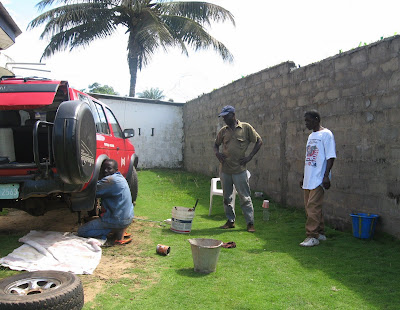
Item—I have been as busy as ever this week, and I never left the yard. The short version of a long and convoluted story is that the owners north of us are building on their property, so our large car gate on the north wall must be moved to the south wall. Not only is there no driveway along the south wall, most of the area is swampland and will need to be built up to support SUVs coming and going. All day everyday this week I have been supervising a large home engineering project for which I am, of course, unqualified. Tons of crushed rock and clay had to be brought in from the truck, then hauled by wheel barrow and spread by shovel. But based on the work, I seem to know as much as the workers. See, my grampa Cain was a road man, so maybe I got some natural skills from him. Anyway, it’s been a gauntlet of stuck trucks and cars, red mud and cement, good workers and bad, but today, Saturday, we finish the job. The saga is illustrated below.


July 24, 2005: Our first day in Liberia. The southern view off our front porch. No wall, but the low land is full of silt and swamp, especially to the right. People fished it for crawdads.

January, 2006: Same view. The wall is complete, the grass is brown, and the warriors are tugging. (Our christmas party)

This week: A bi' ho' has bee' bus' out. (Liberian for "a big hole has been busted out" of the wall to make room for the gate currently on the north wall.

Current: The gate is up and getting finished while Enoch and Trokon play marbles with ones they made out of the red clay we are using for the road we need to build.
Mohammed, Steve and Tom finish the gate job while twelve year old Eastman supervises.
The view outside of our gate and wall, with Deacon Reeves' wall further down and the swamp and stream to the left. The road building has commenced, and the dump truck is stuck in the distance.
"De tru' is heesh." ("The truck is 'hitched-'" another way of saying "stuck.") It took them three hours and another dump truck to haul them out. Note the road behind taking shape. See, my grampa was a road man...

The dump truck was not the only victim of the partially finished road. One of us-- I won't say who-- got it hopelessly mired on the way in. Here our neighbors work to jack it up in order to get something solid under the rear tire.
There she goes! By the way, Hannah is taking these shots-- Yers Trooly is in the mud behind the right rear tire using his weight advantage, pushin' for all he's worth. Renita is at the wheel. Finally got out after an hour.
The red clay arrives on the road, now covered with tons of hand spread crushed rock. The clay is a mucky mess when it rains, but we'll lay sand on it. I've got a great shot of Enoch covered in it after a mud fight with Trokon. He looks like a mini version of the "Thing" from the "Fantastic 4" comic book characters.
The North gate that became a wall. the two-track goes nowhere now, but you can see where the gate used to be.