Monday, June 23, 2008

Elizabeth and Naomi

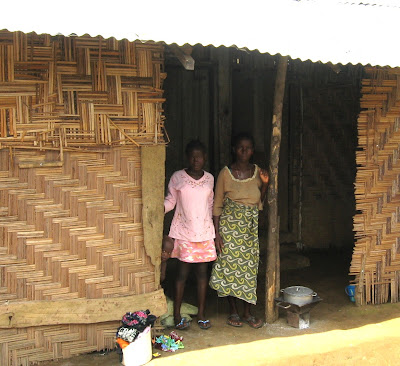
We first met 14 year old Elizabeth in our collaborative work with Active Kids Canada and a Liberia elementary school. AK Canada paid to have a library built and stocked with texts, and wanted to hear about some of the children who attended the school. The principal of the school told us about several children, all of whom have stories worth telling, but we wanted to make sure you met Elizabeth. She is a hard working student, gets good grades, and really loves her school. She lives with her mother Naomi about a mile and a half from the school. There is no father in the picture.

Elizabeth and her mother crush rocks for a living.

In Liberia, the need for crushed rock is high and constant. Almost any construction project in requires crushed rock to provide support in the sandy soil. Roads, cement houses, walls all use crushed rock. Elizabeth and Naomi live in a community of rock crushers near a quarry-- appropriately dubbed Rock Hill. The quarry cliff face is heated, then large rocks broken out by the rock breakers and sold to the rock crushers for $150.00LD ($2.50US) per load. The rock crushers break up the large rocks into small rocks and sell them by the pile for $500LD ($8.00US) to the rock retailers who in turn bag, sell and transport them for roughly $3,000LD (50.00US) for the bags coming from the pile. The method of crushing big rocks is simple. Using a ball peen or other small hammer, the crusher hits rocks into the required smaller size, and throws them onto a pile. When the pile is a few feet high and a few feet wide, the crusher calls the rock seller to come and haul it away.

Elizabeth has been crushing rocks since she was eleven. She starts work when she gets home from school at 2:00pm—Saturdays she works all day—and continues until around 5:00pm. Her early thirties-something mother has been crushing rocks daily for fifteen years. Elizabeth and Naomi sell about three piles every two days for a total average (subtracting the amount the pay to the cliff-side rock breakers) of about US$5.00 a day. The money is just enough to feed this family of two and send Naomi to school.

Most Liberians work very hard in difficult conditions for very little return, and for some like coal makers or rock crushers, the work is almost incredibly demanding or tedious. For Elizabeth and Naomi, and the rest of the residents of Rock Hill, the strain of everyday life shows on their strong and calloused hands, and on their tired faces. For mother Naomi, this is the only method of making a living she has known, and there are no real alternatives. She does not entertain dreams of a better life. For Elizabeth, it is different. You can see it in her eye and in her commitment to school: She wants out of Rock Hill. How long she can maintain that desire is anyone’s guess. At least until she graduates I'm sure. But her desire for a better life is challenged by tradition, inertia, the lack of friends outside Rock Hill, and the general Liberian economy. Eventually she will either use the rocks to help her escape, or the rocks will bury her. I imagine she knows she is in the race of her life.


The quarry from Elizabeth's house. The center of the Rock Hill community.

Elizabeth just getting home to mother Naomi.

Renita, the school principle and I chat with Elizabeth and Naomi about their world. Naomi did not speak English well, and Elizabeth was shy and quiet throughout.

They demonstrated how they spend their days for us.

The Rock Hill area-- piles of rock, everyone by hand-- are everywhere to be seen.


Elizabeth and Naomi, with their latest rock pile behind them.

Weather: The rains have come, as they always do, and as might be expected, not all day yet. During the last week, the rain came mostly at night, but at times heavily for a few hours. Total last week: Monday, 2 inches; Tuesday, 2 inches; Wednesday, 2.25 inches; Thursday 2.25 inches; Friday .25 inches; Saturday, Trace, Sunday, Trace, and by this Monday morning, 1 inch has already fallen. Total for the week: just under ten inches. Hi temps in the low 80’sF and very humid when the sun shines, low temps in the low 70sF.

NEXT WEEK: The Return of the Pros from Dover. We look in on the team from Calvin and Kuyper Colleges as they meet with the MPCHS staff, and tour Liberia with social workers' eyes.

Monday, June 16, 2008

Tienii

Weather: Coming off of a dreary weekend, we are writing on a dreary Monday. We received only about two inches of rain over the past two days, but it fell light both days under a low overcast. There were bits and pieces of sun, but it was mostly cloudy with light and variable winds. Hi temps in the low 80sF, lows in the mid 70sF.

As I mentioned last week, Renita was out past Cape Mount, a few miles from the Sierra Leone border, conducting a two day workshop for a group interesting in better ways to run their micro businesses. While I was running my social worker students through final exam gauntlet in Monrovia, she was enlightening a group of very eager businessmen and women in the little roadtown of Tienii. Here are a few shots.

Next week: A mother and daughter work together—on a rock pile.

In case you were wondering.

Tienii-- just a little village on the way to Sierra Leone, which lies just a bit beyond the hills. The road is one of the best in the country.
The view from the little guest house where Renita overnighted it. You get the sense that the bamboo fence is just keeping the rainforest at bay temporarily. No mosquito nets-- it was a long night.
Renita Reed and James Hillary from LEAD at work inside.

See? She had a great time. The participants really wanted to learn.


The class poses Friday afternoon.


Monday, June 09, 2008

Villages

Weather: After heavy rains last week, we enjoyed a weekend of no precipitation and clear air. Hot and partly cloudy in the daytime, evenings are clear with spectacular night time skies the last couple nights-- looks like night in upper Michigan with the band of the Milky Way clearly visible. This only happens a few nights of the year, so I'm taking it in.

Renita has left me again, this time gone to Cape Mount up near the border with Sierra Leone. She'll be conducting a two day small business management workshop. Me, I'm spending time visiting some local organizations as we continue to discuss future things, and preparing the final exam for the Conflict and Peacebuilding course I'm teaching. Mostly though, I'm missing Renita, and of course Hannah and Noah, who are whooping it up all over the Great Lakes region of North America. Sigh. Tonight, I'll enjoy some fish and rice with Trokon and Eastman, spray the yard for fire ants, and maybe watch "King Kong" with them on dvd. Feel free to drop in. In the meantime, enjoy these shots I took recently of life in various Liberia villages. Coupled with last week's post, it'll help round out a bit of life in much of Liberia-- and the entire region of West Africa.

More of the same-- bumpy and dusty in the dry season, bumpy and slippery-- or impassable-- in the wet season.

Ahh-- I see they fixed that bridge!

Koon Town-- a palaver hut. A community place to gather.

... and the ubiquitous cooking hut. My favorite place in the village.

Looking along the front step of a house-- another palaver hut in the back.

In Kainga Town, a house given some color. When I asked they lady who lives here what they were, she looked at me like I was from Mars and replied, "Dey flowers."

The Center of Gbaye's Town.


The quintessential shade tree.

Monday, June 02, 2008

Let's Play "Livin' Liberian"

Some of you, intrepid souls that you are, have expressed an interest in experiencing life in Liberia, or Africa in general, but haven’t had the means or opportunity to do so. Some of you have said it would be good to have your family experience the reality of living in a developing country, in part to add perspective to life in North America.

After churning it over a bit in our minds, we think we may have come up with a way to create a Liberian experience in a non African context. We call it Livin’ Liberian. It is actually nothing more than applying the living conditions of most Liberians to a set of instructions for you to follow. For some of you, just reading about it may be all the “experience” you want to absorb. For others, you may want to try it with some modifications. But for those radical ones out there, you may want to do the whole thing.


The full version of Livin’ Liberian should take place in the hottest, most humid time of the year. It should last for a week to get a richer sense of it (although longer would be even better). However, even a day or two will work toward an understanding. Of course, there can really never be a full understanding, because we have the option of stopping-- of buying the food we want, of going to the bank, of driving a car, of having running water. Nevertheless, in place of the real thing, this could be meaningful.

You ready? Here we go. Remember, this is the full version. You may modify.

Money
Most statistics say that Liberians live on one US dollar per day per person. We’ll assume you live close to Monrovia. So, put aside $28 for the week to live on, assuming a family of four. If you need more, you will have to ask other people to loan you money, but not more than $1.00 at a time. (NOTE: In North America, some prices will be higher for some items than here. For instance, rice for a family of four may cost $.80 in Liberia, and perhaps $1.20 in NA. Go ahead and buy the food you need, but subtract the amounts listed below from your $1/day/person in your household. Remember, you will have to juggle and make tough choices if you want to eat and get to town and use a phone and use the internet and…)

Water
Turn off the running water in your house. If you don’t do this, you will use the tap or flush the toilet without even thinking. Place a large, clean barrel, cooler, clean garbage pail, or something that can hold 20 gallons of water in one bathroom in your house and a larger receptacle your kitchen. Make an arrangement with a neighbor about a half a block away to buy water from them by the bucket. You can use their hose outside their house instead of drawing or pumping the water. The cost should be about $.05 per bucket. Water is usually drawn twice a day, although we draw it once per day and just do more at that time. You’ll have to carry the buckets of water back to your house and fill the barrels in your bathroom and kitchen. Boil it before drinking. You can cook and wash with it as is. (For an authentic experience, mix a little dirt in the water; most Liberians and Africans do not have clean water and you never really feel clean even after a shower.)

Electricity
Unplug all your appliances, including refrigerator, lamps, stove (If gas, turn it off), fans, air conditioning (if central air, turn the thermostat off), clocks—anything that uses electricity. For light, use candles-- you can buy them for $.15 each. For cooking and food storage, see below. For relief from the heat, get used to it and pray for the rainy season.

Food
If you have read our blog, you have seen typical Liberian food and have found recipes for various dishes. As a temporary Liberian, you will eat rice every day-- and love it-- for the two meals you eat (breakfast and dinner; it is usually only cooked once in a day, so either the breakfast is leftover or the dinner is leftover, depending on the you). The rice is served with a “soup” of some sort on top, with fish or dried meat boiled into the soup. The soup is often cooked from collard greens, squash, cabbage, or other vegetables that can boiled. Remember that you only have $3 per day and you have other expenses as well, so buy your food carefully. Some people just have bread for breakfast so you can opt for that if you prefer. Remember that you have no refrigerator or stove, so people often do their buying on a daily basis (they buy rice one time for the month, if they can afford it, and then the items for their soup daily, otherwise the rice is about $.15 a cup). Pots of rice and the soup should be cooked over coal, so if you have a grill, buy some charcoal and use that (don’t use propane—subtract $00.15 for coal for each meal. If you don’t have a grill, buy a cheap one that can last you for the week from the money that you will be saving on groceriesJ).

Bed Time
Sleep on the floor on a sleeping bag or foam mattress. Remember—candles only!

Toilet Duty
If you are one of the few Liberians with indoor plumbing fixtures, you will flush the toilet, by using a small bucket in the bigger barrel-- fill it with water, and dump it in the toilet and it will flush. If you are like the vast majority of Liberians, you do not have plumbing. Dig a hole in your back yard and use that as a latrine, with leaves for wiping. Not a very hygienic solution, we know, and it wouldn’t go over well in your city, but that’s what people do here, hence the many health issues like cholera.

Shower
Place a cup in your bucket of water, stand in your shower and dump it over your head. You will naturally use less water (either because it’s too cold or because you don’t want to draw too much water); we use about a gallon per day per person for a shower.

Laundry
To wash your clothes, gather two big tubs and fill with water. Buy a bar of soap ($.10 here) and some bleach ($.10 – about two tablespoons). Wash by hand. Rinse. When you are done, spread on your lawn to dry (most people can’t afford to buy the rope or the clothespins to hang their clothes up.)

Transportation
As you see everywhere in the world, the price of gas and diesel are high here as well - $4.05/gallon for gas; $4.70/gallon for diesel. But you will not be driving anyway— very few Liberians own one or can drive. But the prices have increased for public transportation here as well. Since you are earning $1/day/person in your household, we must assume you have a fulltime job. So, pay $.80 for transportation each way ($1.60 per day). In addition, the time spent to get a bus or a taxi can be hours both in the morning and the night. If you go anywhere this week, walk or take public transportation. Go to the bus stop and wait for one or two hours before getting on the bus to really get a feel of what it is like to move around in the city. You could also walk or you could rent a bicycle for $1.00 for the day. (You’ll only need to subtract the Liberian cost from your $1/day/person in household allowance. We know transportation in your town is higher.)

Phone
Most people do not have their own cell phone (there are no land lines), although that seems to be rapidly changing. For the sake of this experience, you may use your own phone but each call will cost $00.10 and should only last a few minutes. The good news is that it does not cost to receive calls here. So keep phone calls very short or call someone and tell them to call you back.

Internet
The cost for the use of the internet is $1.00 for thirty minutes. In addition, you need to take transportation to get there, so add an additional $.30 cents for that.

Summary List of Costs per week-- Budget wisely!
Rice (3-4 cups ) – $0.60, soup ($0.50), meat ($0.70) = $1.80/day x 7 days $12.60
Coal - .15/day x 7 days=$1.05
Water – 0.40/day (8 buckets/day x 7 days)=$2.80
Laundry (1 time per week)=$0.20
Candles – 1 @ 0.15 – 5 used in a week=$0.75
Transportation - $1.60/day for five days=$8.00
Phone – 5 calls @ $0.10 =$0.50
Internet – 1 use per week =$1.30

Although this may be tough for you to get through, the point to keep in mind is that hundreds of millions—perhaps multiple billions—of your fellow human beings do it every day for their entire lives. It gives one pause, does it not?


Hauling water-- they do it every day. The containers, called "gallons", actually 2.5 gallons, bigger ones hold 6 gallons.

Preparing cassava together.


Laundry day-- a main challenge is to keep the kids from stepping on it.

If your rubber boots tear, you may not throw them out and buy new-- you can't afford it. Find broken, discarded flip-flops, tear off the straps, and create a patch by melting the strap onto the rubber.

Hope you don't have any building to do this week, if so, you must make your own blocks.
And if your hut needs a new coat of mud, you gotta do that yourself too-- you can't afford a mud contractor.Hey, just be thankful you don't live in the bush on the other side of a broken road...

... during the rainy season.

Monday, May 26, 2008

ReedNews Update: May Edition

Weather: Partly cloudy and very humid of late, with evening thundershowers and some very heavy rain. Raining about four days out of seven, usually between sundown and sunup, but occasional rain in the day as well. Sunday it rained from 10:00pm until Monday at 3:00am, dropping about 5 inches on us, for a total this week of approximately 8 inches. It will get much wetter. Moderate breezes from the east, mostly in late afternoon, otherwise very light and variable winds providing little relief from the humidity. Daytime temps in the 80sF, low 70s at night.

The global economic downturn is hitting this nation especially hard, and comes at a time when the real gains we’ve seen these last three years are vulnerable. Rice prices have risen by 30% in six months, and the international oil crisis had caused shortages and impacted prices of all imported and transported commodities—which is just about everything. Gas is currently US$4.05 a gallon, and diesel is $4.70 a gallon. Prices of just about everything are up 25-50% since last year. The impact on the people of Liberia—already among the poorest in the world—is difficult to characterize. Liberians are used to living on almost nothing. Almost every Liberian lived on the run, in the bush somewhere as a displaced person more than once during the war. They understand being squeezed in ways most of us cannot imagine. So once again, they are suffering economic oppression, and once again they are at the mercy of forces beyond their control. Here’s more news:

Item-- Vera, our weekday dinner cook and laundry lady, was robbed for the third time since we’ve known her, again in the middle of the night by cowards armed with machetes. They broke her door, beat up a young man staying with the little family, stole the $30.00 or so she had (and that’s all she has), took her food, some clothes and even the mattress she lays on the floor to sleep on with her daughter. A terrifying experience for this single mother of four. Hannah had some money given to her by one of you to use "as she wanted," so she bought Vera a new foam mattress.

Item-- Sunday morning, rogues continued their work, this time at the local church many of you have helped build and supply. They broke in, stole the chairs and electrical wires for the generator.

Item—On a more positive note, last week LEAD graduated its 8th, 9th and 10th business classes, in Monrovia, Buchanan and Gbarnga, respectively. LEAD now runs two business empowerment programs, one for very small businesses that includes a two day workshop and loans of up to $300.00US per participant, the other for larger businesses includes loans of up to $1800.00US and a twelve week, 36 hour business course. It was this larger program that graduated the classes this time. In Gbarnga, the proud grads marched through the city in parade fashion, banging drums and singing in celebration.

Item—The Pros from Dover are returning! The Social Work team from Calvin and Kuyper Colleges will be in Monrovia in June to continue their assistance in the young Mother Patern College BSW (Bachelor of Social Work) program. They’ll be bringing textbooks, tweaking the curriculum, and preparing for their visit in January—they’ll be teaching two courses.

Item-- We are temporally losing our children. Hannah and Noah are traveling today from Liberia to North America for three months. This is by far the longest we’ve been without them, and we are mixed about seeing them gone for so long. But we believe they will have a great time. They will be traveling with a family we’ve come to know and trust, and will be picked up in Chicago by our friend Mary Vermeer.

Vera, on a happier morning. She's doing better today.

The 10th LEAD class marching down the Gbanga main road.


Hundreds of business men and women empowered by LEAD. These are the latest.

Monday, May 19, 2008

Around Monrovia


Weather: Rain more frequently now, especially in the evenings, at least every third night. Last night we got about .75 inches in a couple hours. Day time is humid as ever with temps in the 80's. Night times are cooler now, and we are chilly with in house temps dipping to 79F.

Now that we are fully back into the Liberian soup, I thought a little tour of the streets of Monrovia might be in order. We live outside the city, and while some of our work is miles away, both Renita and I find our work centers in Monrovia.

Monrovia is really the only true "city" in the country, all the others amounting to villages of varying sizes, none much more than 20,000 in population. The civil war caused Monrovia’s population to double, as displaced people streamed into the relative security of the capital. Today, the city cannot support all of its residents, so many wander the streets, some begging, some stealing, everyone looking for any opportunity to get some cash. Estimates are Monrovia now holds over a million people, or over a third of the population of the country. It is not a pretty city, for over fifteen years of neglect has left it scarred and dirty. Not yet fully supplied with the electricity it enjoyed before the war, with a poor water supply and meager sanitation, with insufficient and roads constantly needing repair, the city struggles to clean its act up. In the four years since we first visited, we have seen real progress. The administration of Ellen Johnson Sirleaf has worked hard against a tradition of corner-cutting, skimming off the top, extortion and every other type of corruption invented by man. She deserves a Nobel Prize.

Anyway, join Renita and I on a trip literally around this town, which like "Tobacco Road," may be despised because it’s filthy, but loved because its home. If you look close, you'll see signs of hope everywhere.


Not far from home, the Chinese have consructed an asphault and concrete-making factory as it supervises road repair throughout the country. Heading North.


Our first major intersection as we appoach the city-- this is ELWA junction. Turn (bend) to the left to head into the city.

One of the several new used buses for much needed public transportation. Monrovia needs a lot more!


As we head into the city, we pass UNMIL headquarters-- UNMIL stands for the United Nations Mission in Liberia. Still one of the largest in the world, with thousands Peacekeepers. They will be leaving a little at a time, begininng this fall.


The Capitol Building--being refurbished with the help of USAID-- the good people of the USA. And directly across the street-- the President's building, called the White House. Oddly, signs on the gate state "Photography Strictly Forbidden." Not sure what that means, but since I got this photo online, they can't bust me. I hope.

Downtown Monrovia-- this is Center Street.

Leaving downtown, nearing an area called Red Light-- thousands of little roadside shops. Heading East.

How you like the ride so far? No spitting out the windows!

After circling the city, this checkpoint is on the east side. This during the dusty dry season.


A very common sight-- not only grossly overloaded vehicles, but this one with bags of charcoal for cooking on coal pots. The coal is made in the interior and trucked in. Now heading Southwest.

On the way back, this is a side road to our friends' house-- we need to be in 4WD to make it.

Finally home, the journey 'round Monrovia over. Eastman waits by the big gate.

Wednesday, May 14, 2008

Liberian Cuisine, Part 2

Weather: High humidity with evening thundershowers becoming more common. Daytime temps in the upper 80sF, nighttime lows in the low 70sF.

We arrived back in Liberia after just under two weeks in Gambia and we were instantly engulfed. Engulfed I say. First of course by the humidity, which smacked into us like a wall the second we exited the plane, but also by our Liberian life waiting for us. By the end of the day, we had 1) attended the graduation ceremonies of LEAD’s 8th business class, 2) hosted an impromptu version of our annual “plum party” for about 15 of our neighbor kids (The mangos are ripe and the kids have a riot trying to harvest the allotted amount before I kick ‘em out.), 3) walked Enoch over to his family’s house and had a long talk with them about the eleven year old’s out of control behavior of late, 4) discovered we had a second deer in our yard, given to us by our friends who are about to go to Canada for a few months, and 5) spent a frantic half hour with the neighborhood kids trying to catch the deer who got out our gate while we were hauling water, (Miraculously, we caught her.) Needless to say, we were dog tired by the end of the day. We are still getting back into it; as I write, Renita is home schooling, and I—well, you can see what I am doing.

So while we are getting up to Liberian speed, I thought I’d introduce you to three more Liberian dishes, all three of which we eat regularly.

Water Greens
Water greens look a little like potato greens when cooked, but have a different texture. To me they are like a slightly slimier (Slimy actually is called “slippery” here, and Liberians seem to like the texture) version of spinach—they definitely have that strong spinach flavor.

To prepare: For four adults Remove stems and wash 4 bunches of greens thoroughly. Cut or tear into fine shreds. Combine with two cups chopped onions, and hot pepper and fry in one half cup of oil for 7-10 minutes, stirring constantly. Place into a pot with water. Add chicken or beef cube, salt, black pepper, seasoning salt to taste. Add pre-cooked meat—we prefer cow meat—but anything (dried fish, fried fish, boiled pig’s feet, chicken turkey) you like is acceptable. Boil away most but not all of the water. Serve over rice.

Dum Boy (with Bene Seed)
Dum Boy is a milder version of its much more famous cousin, fu fu (or foo foo. You get the idea.) Dum boy is not nearly as complicated to make as fu fu, and we prefer it to the strong tang of the fermented fu fu. Every Liberian will tell you “do not chew dum boy, just swallow.” As for me, I gotta chew it a couple times before I can get it down. It is very sticky and gelatinous. Here is what it looks like before the soup goes on top:

To Prepare: You need a large mortar and pestle, and to grab a bunch of cassava—the root not the leaf, and grate it into a bowl. Take the grated cassava, place it into a plastic bag, and put the bag into a pot of boiling water. Boil for a half hour to an hour. When the cassava is cooked and tender, dump into a mortar and begin pounding with your trusty pestle. Pound until the cassava becomes a sticky paste. Form these into balls— and serve with soup.

Bene Seed Soup
You can eat dum boy with anything of course; it does not have much flavor and is very starchy. We prefer peanut soup or bene seed soup. Bene seed is sesame seed. You purchase little bags of bene seed in any market. Here is what it looks like on dum boy:

To prepare: Take about a cup of bene (sesame) seed and toast it in a pan over a coal pot or stove. Make sure all seeds get golden brown or more. Remove the toasted seeds and place them in your mortar and pound them into a pulp. In another pan, fry two chopped onions, peppers to taste, and chicken or beef seasonings, depending on the meat you will add. Add any pre-cooked meat you prefer—we like turkey—and fry a bit more. Put the cooked ingredients into a pot, add water to fill the pot and the bene seed. Boil the mixture for a half hour. Some people add a bit of flour to thicken, others toss in a couple of diced potatoes. Sometimes we add noodles. Serve over the dum boy (or rice).

Jollof Rice
Jollof rice is a favorite all over West Africa, and you can find dishes like this all over the world. Its easy to make, and easy to dress up. We eat it about once a week—usually on Fridays. We make a lot of it and feed a few friends. Trokon does not like it much—too much tomato.

To Prepare: Fry two onions, a minced clove of garlic, and peppers to taste in a half cup of oil. To this add five small tins—about a cup and a half—of tomato paste. Stir it all together and fry it up a bit. Remove and place in a large pot. Add enough water to cook six cups of rice (this depends on how you like your rice. Liberians like their rice soft, I like it “el dente.”) Boil the mixture together. Cook the meats you wish to add—anything but fish. Like many Liberian dishes, it is preferable to serve a dish with two (or more) kinds of meat in the dish. We prefer chicken wings with beef (called cow meat here), but when on a budget, we slice up some hot dogs (here called sausage.) By the way, true sausage would be delicious in jollof rice. We can’t get it here, or else its too expensive. Once cooked, set the meat aside. Add the rice to the boiling pot of tomato paste and seasonings. When the rice is done, add the meat and a can of mixed vegetables. We also chop up some fresh tomatoes and mix in just before serving.

Friday, May 09, 2008

A Few Obligatory Vacation Shots

Weather: The glorious winds have really picked up at the beach, and I for one could not get enough if it knocked me over. Winds averaging a steady 35-40 mph last night, a steady 20mph during the day. Hot, dry daytime temps (around 30 C, 86F), and nightime temps much cooler (20C, 68F).
.
We are in our final weekend in the Gambia-- a lot has happened and in our meeting with other team members, we know a lot more about our next steps in Liberia and beyond.
But all of that can wait. Today, and through Monday, we are still embracing our time here. And of course, we are taking pictures. Here are a handful.
The wind blows all day-- our hangout at sunrise...

... at noon-- here you can see the palms bending with the breeze--...


... and in the evening. I know the shot is cliche' as can be, but it also happened to be the view out my front door last night.

The countryside of Gambia/Senegal is much drier than Liberia.

Noah took this shot of a red colobus while on a four hour walk with his sister and some friends.

He also got this view when a family of vervet monks showed up, possibly looking for a handout.
Our beach at mid day, facing North.

Late afternoon, looking toward Liberia, hundreds of miles to the south.