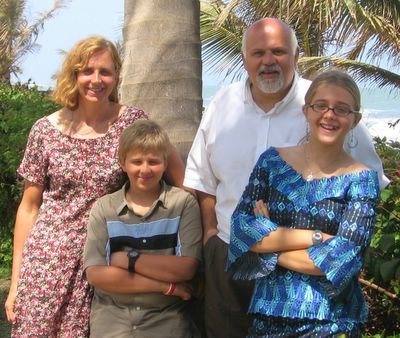
As I write this entry, it is 6:10pm at Mother Patern College. I am waiting in the palaver hut in the central courtyard. Even though the class I teach ended at 4:00pm, I remain. I am waiting for transportation. Yes, I have a car, and no, Renita is not using it. I drove it in today. Sometime within the next hour, I hope I will drive it home. I’m getting hungry. The guy who just checked on it said it would be ready in ten minutes. Translated from Liberian English, I’m guessing I’ll drive out of here in 45 minutes, at 6:55pm.
The car is in the shop. Again. Wheel/Suspension related problems. Again. Since we’ve been here, we’ve had zero problems with the engine or the transmission. The Nissan Pathfinder, nine years old, runs fine. But Liberia is murder on that place where the Nissan finds the path. Mohammed, the MPCHS mechanic, has replaced bushings twice, ball joints, wheel bearings, breaks twice, shocks (rear, now front), gone through two alignments, repaired drums, and it is now on its second set of brand new tires. And you know what? 90% of our driving is back and forth the 12.5 miles to Monrovia. That’s how bad the best roads in the country are.
Here in Monrovia, parts are expensive and mechanics hard to find, but if found, mechanics are less expensive than in the States. So repair work is affordable. However, we are so regularly dumping money into this vehicle we are asking ourselves a very familiar question— will it be cheaper to dump it and buy another or keep sinking a few hundred bucks into it each month?
This is a little problem really… “I complained that I had car problems until I met a man with no car—and no feet, home, or food--” Like the guys who wait for me every time I come out of any building in downtown Monrovia. So I’m really just whining to pass the time.
Well, here he is-- Mohammed with my car. I’m outa here.
Hey! It’s 6:50pm! Five minutes early!
Thursday, March 22, 2007


Monday, March 19, 2007
ReedNews Update
The weather is a-changin’ after four months of almost no rainfall. The days alternate sunny and cloudy, and every other night, it rains. This is the transition time, between the rainy and dry season. It mirrors the transition time in October, at the close of the rainy season. It is characterized by brief but strong nighttime winds carrying thunderstorms followed by steady rain that lasts hours, but typically over by morning. The mornings are relatively cool—low 70’s— but the day still heats up into the mid 90’s on sunny days. Now some news:
Item- The spring seems to be visitor season; we have just said goodbye to brother Brian and are awaiting brother Henry and mother Marrie in a couple weeks. Currently Madison Square Church and Nehemiah-Liberia Group member Mary Vermeer is here with her daughters Jennifer and Elizabeth. We’ll get a picture of them later in the week.
Item- FoCDA continues to produce. The area community development association collaborated again with my pals at Mother Patern College to present a workshop titled “Nutrition, Food Preparation and Preservation.” It was an excellent presentation, attended by about fifty neighbors. Renita said, “I think these workshop could save somebody’s life.”
Item- I had a chance to facilitate a seminar for about 120 people last week. It was a marriage conference, and we had a lively time addressing issues. Family life has been deeply affected by the turmoil of the last twenty-five years, so it was fascinating discussing Liberian marital and family realities vs. the ideal. The biggest issues relate to mutual distrust, and male/female roles in marriage.
Item- The market place continues semi-steady progress. Building the market has produced some tension and arguments between various groups in the community, which has in turn created lively community meetings. Intergroup and even intragroup yelling and finger pointing happen as some neighbors suddenly want a say now that the market is an inevitable reality. This conflict is all part of the process, and is in fact necessary to building a cohesive community. The underlying conflicts and mistrust have been there a long time, lying dormant. It takes a large community activity like this to bring the conflicts out so the members can transform them into something beautiful.
Item- We released the monkey. After several months of debate, we decided to go with our heads and take the monkey back to the forests and allow her a chance to be free. So we selected a spot where monkeys had been seen and let her go. It was sad for us, but we knew it was the right thing to do. Beyond principle, she had become aggressive toward some people, especially when she was being held by Renita or me. She was particularly hostile toward Hannah, giving her a nasty series of bites. After six months being chained to a tree, it was time for her to return to the wild.
Item- The Reeds are returning for a visit to Michigan! It started when Partners Worldwide asked Renita to come to Grand Rapids for a couple weeks for a conference. We got to thinking: “We are already one quarter of the way there. Could we find the funds to get us all over?” We did. Nehemiah-Liberia Group sprung for another ticket, and thanks to many of you, we are doing well enough for the remaining two. We will be in Michigan the month of June, working, visiting as many of you as possible, and taking a little break from West Africa after two years.
Item- The spring seems to be visitor season; we have just said goodbye to brother Brian and are awaiting brother Henry and mother Marrie in a couple weeks. Currently Madison Square Church and Nehemiah-Liberia Group member Mary Vermeer is here with her daughters Jennifer and Elizabeth. We’ll get a picture of them later in the week.
Item- FoCDA continues to produce. The area community development association collaborated again with my pals at Mother Patern College to present a workshop titled “Nutrition, Food Preparation and Preservation.” It was an excellent presentation, attended by about fifty neighbors. Renita said, “I think these workshop could save somebody’s life.”
Item- I had a chance to facilitate a seminar for about 120 people last week. It was a marriage conference, and we had a lively time addressing issues. Family life has been deeply affected by the turmoil of the last twenty-five years, so it was fascinating discussing Liberian marital and family realities vs. the ideal. The biggest issues relate to mutual distrust, and male/female roles in marriage.
Item- The market place continues semi-steady progress. Building the market has produced some tension and arguments between various groups in the community, which has in turn created lively community meetings. Intergroup and even intragroup yelling and finger pointing happen as some neighbors suddenly want a say now that the market is an inevitable reality. This conflict is all part of the process, and is in fact necessary to building a cohesive community. The underlying conflicts and mistrust have been there a long time, lying dormant. It takes a large community activity like this to bring the conflicts out so the members can transform them into something beautiful.
Item- We released the monkey. After several months of debate, we decided to go with our heads and take the monkey back to the forests and allow her a chance to be free. So we selected a spot where monkeys had been seen and let her go. It was sad for us, but we knew it was the right thing to do. Beyond principle, she had become aggressive toward some people, especially when she was being held by Renita or me. She was particularly hostile toward Hannah, giving her a nasty series of bites. After six months being chained to a tree, it was time for her to return to the wild.
Item- The Reeds are returning for a visit to Michigan! It started when Partners Worldwide asked Renita to come to Grand Rapids for a couple weeks for a conference. We got to thinking: “We are already one quarter of the way there. Could we find the funds to get us all over?” We did. Nehemiah-Liberia Group sprung for another ticket, and thanks to many of you, we are doing well enough for the remaining two. We will be in Michigan the month of June, working, visiting as many of you as possible, and taking a little break from West Africa after two years.
 Noah and his bestest buds, Trokon and Eastman, and Hannah and her special friend Andrew, hangin' out amongst the blocks on an overcast day.
 The latest on the market. Rafters up, waiting for zinc.
 Yers Trooly, tired of washing laundry by hand, tries another approach.
 Finally, a couple parting shots of our favorite primates. Here, Unca' Brian before he leaves, surrounded by Trokon, Odell holding Jackie, Margaret with Bandit, with Blessing holding Max, and Eastman.
 Our last image of the Monkey, as she cautiously steps off into the bush.
Monday, March 12, 2007
The National Workshop on Mental Health Worker Standards and Nomenclature. Did Somebody Yawn?
Udated March 16

Local Weather: Days alternating between overcast and sunny. Some light rain. Temps in high 90’s and humid in the day on sunny days, upper 80’s on cloudy days. Upper 70s and humid at night. Precipitation: Approximately 3 inches total rainfall since mid November.
Granted, it’s not the “hot new topic in development,” like entrepreneurial and business empowerment, and it’s not easily understood, like community development, and it’s not even all that interesting, like building partnerships for creating important new training curricula. But Liberians on the front lines of the mental health battle will tell you it is a critical necessity if this country is going to survive and prosper. Let me tell you about it.
All of you know that Liberia is a post war country, a nation and a people just three and a half years from 14 years of conflict that saw the country virtually destroyed, its people exposed to horror and heart break, and ten percent of its population dead. No one has escaped exposure to traumatic events, and practically everyone still lives with the effects. You see it everywhere in the ways Liberians act toward one another. Yes, they are amazing survivors. Yes, many have overcome. Yes, the country is full of heroes. But there are open wounds. High levels of mistrust, dishonesty, opportunism, rage, alcohol and drug abuse, family violence, sexual abuse and prostitution permeate this culture.
As a result, since the mid 1990’s, NGO’s have been offering untold numbers of brief “psychosocial training programs” of two or three weeks length to Liberians and sending them back into cities and villages to provide what they might call “trauma healing,” or “psychosocial counseling,” or even “Training of Trainers,” which means people with virtually no training go on to train others in all kinds of mental health interventions. You may imagine the psychological and spiritual chaos that has resulted.
Granted, it’s not the “hot new topic in development,” like entrepreneurial and business empowerment, and it’s not easily understood, like community development, and it’s not even all that interesting, like building partnerships for creating important new training curricula. But Liberians on the front lines of the mental health battle will tell you it is a critical necessity if this country is going to survive and prosper. Let me tell you about it.
All of you know that Liberia is a post war country, a nation and a people just three and a half years from 14 years of conflict that saw the country virtually destroyed, its people exposed to horror and heart break, and ten percent of its population dead. No one has escaped exposure to traumatic events, and practically everyone still lives with the effects. You see it everywhere in the ways Liberians act toward one another. Yes, they are amazing survivors. Yes, many have overcome. Yes, the country is full of heroes. But there are open wounds. High levels of mistrust, dishonesty, opportunism, rage, alcohol and drug abuse, family violence, sexual abuse and prostitution permeate this culture.
As a result, since the mid 1990’s, NGO’s have been offering untold numbers of brief “psychosocial training programs” of two or three weeks length to Liberians and sending them back into cities and villages to provide what they might call “trauma healing,” or “psychosocial counseling,” or even “Training of Trainers,” which means people with virtually no training go on to train others in all kinds of mental health interventions. You may imagine the psychological and spiritual chaos that has resulted.
Throughout Liberia, there are thousands of men and women with almost no training, calling themselves “Counselors”, “Trauma Specialists”, or “Social Workers.” Some of them are talented and dedicated, possessing natural skills to help others and the wisdom to know their limitations. Many do not. Too many are on the field, employed by NGOs, opening wounds, retraumatizing victims, and giving the worst kind of advice. Too many of these poorly trained workers do more harm than good.
This is where the National Mental Health Task Force comes in. Mandated by the Ministry of Health, we have been working for the last year and a half to come up with minimum training standards and appropriate titles or nomenclature for these workers. Standards are necessary to insure professional training, and we also want to make sure that when one calls himself or herself a "social worker" or "counselor," people can trust they are being served by individuals with extensive traing and field experience. The Ministry of Health hopefully will adopt these standards and make further recommendations to the legislature to put them into law.
Last week we reported our suggestions to some of the heads of these large NGOs and workers in the field for their reaction. It was well attended, and we went away feeling like our task force is making a conversation happen that is long over due and may someday substantially improve the quality of care people are receiving all across Liberia.
As I say, this kind of work is not “sexy development work.” Most people’s eyes glaze over when I start talking about my work with is group. I mean, who but a shrink type or a geek would care about “mental health standards and nomenclature?” But it is necessary for this country’s recovery. It is peacebuilding work-- it is Kingdom work.
This is where the National Mental Health Task Force comes in. Mandated by the Ministry of Health, we have been working for the last year and a half to come up with minimum training standards and appropriate titles or nomenclature for these workers. Standards are necessary to insure professional training, and we also want to make sure that when one calls himself or herself a "social worker" or "counselor," people can trust they are being served by individuals with extensive traing and field experience. The Ministry of Health hopefully will adopt these standards and make further recommendations to the legislature to put them into law.
Last week we reported our suggestions to some of the heads of these large NGOs and workers in the field for their reaction. It was well attended, and we went away feeling like our task force is making a conversation happen that is long over due and may someday substantially improve the quality of care people are receiving all across Liberia.
As I say, this kind of work is not “sexy development work.” Most people’s eyes glaze over when I start talking about my work with is group. I mean, who but a shrink type or a geek would care about “mental health standards and nomenclature?” But it is necessary for this country’s recovery. It is peacebuilding work-- it is Kingdom work.
The workshop. After our report, the paricipants divided into subgroups to give feedback and suggestions. Here one group reports.

They loved us.
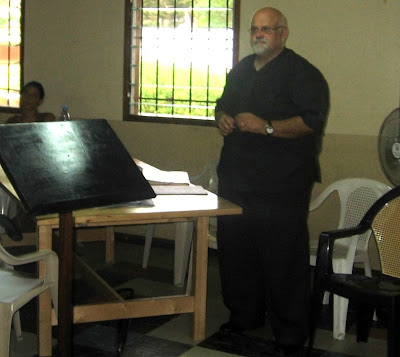
Yers Trooly, appointed "MC" getting ready to yank someone for going too long.
Monday, March 05, 2007
Q & A
Local Weather: Temp mid 90’s and humid in the day, upper 70s and humid at night. Partly cloudy most days. Precipitation: Two days with rain since mid November, approximately 1.5 inches total.
We have received many emails and notes in the last twenty months. We might miss one or two, but we try to answer them all. We figure others have similar questions from time to time, so here is a smattering of those questions, with our response.
Q. How much does food cost?
A. It depends where you shop and what you want to eat. A Liberian meal, which we eat every week day, costs us an average of $5.00, and with it we feed about eight people, four dogs, a monkey and a deer. A weekend “American meal” costs between $10.00 and $15.00 for four people and the animals. Here is a list of random items, expressed in US dollars. The red is purchased from city grocery stores, the green purchased from open markets:
1 bunch of Potato greens: $.20
16 oz rice: $.20
50 kg bag (120lbs) rice: $22.00
A six pac of soda pop: $4.50
A large pineapple in the city: $5.00
A large pineapple in the country: $1.00
1 pac Chicken hot dogs: $1.00
1 pac Beef or Pork hot dogs: $8.00
16 oz. Ranch dressing: $4.00
Turkey (2 wings): $1.25
Pringles potato chips: $3.50
1 lb Sliced lunch meat (salami or ham only): $5.00
1 loaf bread $1.20
1 loaf bread $.30
Fresh Milk: unavailable
1lb Apples $4.00
1lb Mangoes $.40
1 quart ice cream: $8.00 (we have no freezer anyway)
12 oz Gin $1.00
Q. What’s the status on all those people being displaced because the roads are being widened?
A. The good news for them is that nothing has happened yet, although the yellow “X-MPW”s painted on houses, schools, churches, and businesses are steadily moving down the road. Renita and I think there is no way we will see structures coming down this year: too late in the dry season. My guess is everyone will get a year reprieve. But you never know.
Q. How are the solar panels treating you?
A. The panels are fine, although in this dusty season we have to climb onto the zinc roof and rinse them off. The solar batteries are still supplying us with dc power for the refrigerator and fans, and we found cheap modified sine wave inverters here for our computers and for charging stuff in the day. By the way, the country is going 220w, so finding 110w items here is getting increasing difficult. Finding 110 inverters was worth celebrating.
Q. Hey, how is Bob doing on the weight thing?
A. Hey, why don’t you just come out and call me fat? Ok, ok, I get a bit testy. As some of you know, I lost a small portion of my large amount of fat before we came here, about 70 pounds worth. I did it by getting a lot of support and eating fewer calories, and focusing on non processed carbs and protein. Since I’ve been here, the low protein, white rice diet has made every day a struggle to maintain what I lost. I’ve gained 20 pounds in the year and a half we’ve been here, but have leveled off and am fighting the good fight.
Q. We haven’t seen much of Hannah lately. How’s she doing?
A. Hannah continues to change, as adolescents do, but we could not be more impressed or proud of her. Her courage, strength of character, and helpfulness are inspiring. Look for a blog on her soon. I just need to talk her into letting me publish that picture of her eating spaghetti.
Q. How do you get your news? Do you have TV?
A. We are always way behind in getting big news stories compared to the West. We do not have TV connected to the airwaves, although we have a TV to watch movies.
Q. What do you miss most from your life in the US?
A. Faces of friends and family. A cool dry breeze. Cheap but good chocolate. Flushing toilets. Good loamy soil. Maple trees. Michigan Octobers. Looking out my window and pretending all is right with the world.
We have received many emails and notes in the last twenty months. We might miss one or two, but we try to answer them all. We figure others have similar questions from time to time, so here is a smattering of those questions, with our response.
Q. How much does food cost?
A. It depends where you shop and what you want to eat. A Liberian meal, which we eat every week day, costs us an average of $5.00, and with it we feed about eight people, four dogs, a monkey and a deer. A weekend “American meal” costs between $10.00 and $15.00 for four people and the animals. Here is a list of random items, expressed in US dollars. The red is purchased from city grocery stores, the green purchased from open markets:
1 bunch of Potato greens: $.20
16 oz rice: $.20
50 kg bag (120lbs) rice: $22.00
A six pac of soda pop: $4.50
A large pineapple in the city: $5.00
A large pineapple in the country: $1.00
1 pac Chicken hot dogs: $1.00
1 pac Beef or Pork hot dogs: $8.00
16 oz. Ranch dressing: $4.00
Turkey (2 wings): $1.25
Pringles potato chips: $3.50
1 lb Sliced lunch meat (salami or ham only): $5.00
1 loaf bread $1.20
1 loaf bread $.30
Fresh Milk: unavailable
1lb Apples $4.00
1lb Mangoes $.40
1 quart ice cream: $8.00 (we have no freezer anyway)
12 oz Gin $1.00
Q. What’s the status on all those people being displaced because the roads are being widened?
A. The good news for them is that nothing has happened yet, although the yellow “X-MPW”s painted on houses, schools, churches, and businesses are steadily moving down the road. Renita and I think there is no way we will see structures coming down this year: too late in the dry season. My guess is everyone will get a year reprieve. But you never know.
Q. How are the solar panels treating you?
A. The panels are fine, although in this dusty season we have to climb onto the zinc roof and rinse them off. The solar batteries are still supplying us with dc power for the refrigerator and fans, and we found cheap modified sine wave inverters here for our computers and for charging stuff in the day. By the way, the country is going 220w, so finding 110w items here is getting increasing difficult. Finding 110 inverters was worth celebrating.
Q. Hey, how is Bob doing on the weight thing?
A. Hey, why don’t you just come out and call me fat? Ok, ok, I get a bit testy. As some of you know, I lost a small portion of my large amount of fat before we came here, about 70 pounds worth. I did it by getting a lot of support and eating fewer calories, and focusing on non processed carbs and protein. Since I’ve been here, the low protein, white rice diet has made every day a struggle to maintain what I lost. I’ve gained 20 pounds in the year and a half we’ve been here, but have leveled off and am fighting the good fight.
Q. We haven’t seen much of Hannah lately. How’s she doing?
A. Hannah continues to change, as adolescents do, but we could not be more impressed or proud of her. Her courage, strength of character, and helpfulness are inspiring. Look for a blog on her soon. I just need to talk her into letting me publish that picture of her eating spaghetti.
Q. How do you get your news? Do you have TV?
A. We are always way behind in getting big news stories compared to the West. We do not have TV connected to the airwaves, although we have a TV to watch movies.
Q. What do you miss most from your life in the US?
A. Faces of friends and family. A cool dry breeze. Cheap but good chocolate. Flushing toilets. Good loamy soil. Maple trees. Michigan Octobers. Looking out my window and pretending all is right with the world.
Monday, February 26, 2007
A Working Fun Sad Weekend
Weather: Daytime temps around 100F, nighttime temps lower 80's indoors, upper 70s outdoors. Hazy and humid. Two days of rain since Mid November.
There is never a dull moment around home or in our work, and this weekend was no exception. Our brother-in-law Brian is here to add to the craziness. Saturday Brian was off celebrating Lifewater Canada's 200 well, and Renita and I were busy working with FoCDA clearing the market site for more construction. We joined about thirty community friends on the project in 100 degree heat. It was a hoot. Brian returned later and for the rest of the weekend, hung around with us.
On Sunday we went to the beach to get some swimming in. The water was actually refreshing and the beach was unusually crowded. After a few minutes of fun in somewhat treacherous water (The beach has a serious rip tide), I noticed Brian-- who is a paramedic when not digging wells in Liberia-- had vanished. I wasn't worried about where he was; Brian is an excellent swimmer. I finally caught a glimpse of him a few yards away-- he was pulling a young Liberian man back to shore. Apparently, the young man's brother had just went under a few moments before and the young man was near downing himself looking for him. Brian brought him in. But his brother was gone. We and almost everyone left the water to look for any signs of the young man from the higher vantage point of the beach. But everyone knew how this would turn out.
Since we have been here, we have heard of dozens of people drowning on the nearby beaches. It happens far too frequently. I've almost become callous to the fact that these beaches are dangerous; I'm getting used to hearing about another drowning-- "so what else is new?" That's the way it is here, people working to buld a community-sustaining market, people trying to take a break from the pressures of living here, people dying in the midst of the activity, people grieving-- but not for long. In Liberia, extended grieving for a young drowning victim is a luxury few can afford.
 The FoCDA folks (Renita on the left) clearing the market site. The poles are all up and next week we start on the roof.
There is never a dull moment around home or in our work, and this weekend was no exception. Our brother-in-law Brian is here to add to the craziness. Saturday Brian was off celebrating Lifewater Canada's 200 well, and Renita and I were busy working with FoCDA clearing the market site for more construction. We joined about thirty community friends on the project in 100 degree heat. It was a hoot. Brian returned later and for the rest of the weekend, hung around with us.
On Sunday we went to the beach to get some swimming in. The water was actually refreshing and the beach was unusually crowded. After a few minutes of fun in somewhat treacherous water (The beach has a serious rip tide), I noticed Brian-- who is a paramedic when not digging wells in Liberia-- had vanished. I wasn't worried about where he was; Brian is an excellent swimmer. I finally caught a glimpse of him a few yards away-- he was pulling a young Liberian man back to shore. Apparently, the young man's brother had just went under a few moments before and the young man was near downing himself looking for him. Brian brought him in. But his brother was gone. We and almost everyone left the water to look for any signs of the young man from the higher vantage point of the beach. But everyone knew how this would turn out.
Since we have been here, we have heard of dozens of people drowning on the nearby beaches. It happens far too frequently. I've almost become callous to the fact that these beaches are dangerous; I'm getting used to hearing about another drowning-- "so what else is new?" That's the way it is here, people working to buld a community-sustaining market, people trying to take a break from the pressures of living here, people dying in the midst of the activity, people grieving-- but not for long. In Liberia, extended grieving for a young drowning victim is a luxury few can afford.
 The FoCDA folks (Renita on the left) clearing the market site. The poles are all up and next week we start on the roof.
  Having an ad hoc meeting, discussing fees for market tables and quelling rumors.
 Everyone, young and old, got into the act.
 Next day, Uncle Brian the well digger up to no good with Trokon, Enoch, Hannah, Odelle and Eastman. Trying to make water balloons.

Doesn't this guy ever stop hanging around wells? Its ok, he's pumping water for our daily needs. Did it in record time too.

Later, its off to the beach. Hannah on the left, with Noah, Yers Trooly and Brian on the right. The kids on the beach include Trokon, Blessing and Odelle.

But exactly at that moment, a young man was dying yards away. After Brian brought the struggling brother back to shore, the beach crowd gathered and scanned the water. As of Monday, the body has yet to be recovered.
Monday, February 19, 2007
LifeWater Comes to Foster Town
FoCDA-- One of the commitments Renita and I share-- is the new Foster Town Community Development Association. FoCDA is also a Bassa word meaning rest. FoCDA is working on several projects-- security, HIV-AIDS education, community workshops, building a local market, and now drinking water. Thousands of people in the area have access to just a handful of maintained closed wells, and only a few more than that drink from unsafe open wells. LifeWater Canada, a group that includes our brother-in-law Brian Schenk is here in force beginning Wednesday to dig wells at various locations around the country. Its in-country counterpart, LifeWater Liberia, was here Saturday to conduct a water safety workshop and to discuss putting four new hand pump operated wells in the Foster Town area. This of course is a drop in the bucket (sorry) compared to the need for safe water, but it is a start.
In other FoCDA news, the market is slowly taking shape. The framing poles go up this week, and the roof poles will follow. We do not have the funds yet to put zinc on the roof, but we believe this community will make that happen. Yesterday was the monthly community forum. It is an honor to sit in on these meetings and hear how our neighbors are problem solving their way to a better life.

The LifeWater workshop focused on water usage and some hygiene stuff. Here the presenters test to see who knows the proper method of hand-washing. About one-third got it right.

A little reminder not to poopoo around a water source.

The women of FoCDA at the market site. The poles (called "sticks" here) are just going up.
Thursday, February 15, 2007
ReedNews Update
Local Weather: Temp around 100F (38c) and humid in the day, lower 80sF (27-29C) and humid at night. Mostly Sunny Today. Precipitation: one day of rain since mid November, approximately 1 inch.
News Headlines: A Partner Conference in Washington DC over Liberia is just concluding with some very good news for Liberia's future. Up until now, the country has been hamstrung in its plans to rebuild because it could not access World Bank funds. This barrier was in large part due to the nearly four hundred million dollars Liberia owes the US. At the Partner Conference Tuesday, Secretary of state Rice announced the debt would be forgiven. This is huge, and paves the way for millions in reconstruction and business investment dollars. Stay tuned.
News Headlines: A Partner Conference in Washington DC over Liberia is just concluding with some very good news for Liberia's future. Up until now, the country has been hamstrung in its plans to rebuild because it could not access World Bank funds. This barrier was in large part due to the nearly four hundred million dollars Liberia owes the US. At the Partner Conference Tuesday, Secretary of state Rice announced the debt would be forgiven. This is huge, and paves the way for millions in reconstruction and business investment dollars. Stay tuned.
In other news:
-Guinea, our next door neighbor to the north is erupting in violence and under martial law. Continue to pray for peace and justice.
-After a week delay, Renita is in Buchanan, interviewing prospective participants in the upcoming business class.
-I'm teaching another course at MPCHS-- Interpersonal Communication- while continuing to dialogue with the folks at Calvin College about the BSW program.
-The Reeds have two new puppies, Bandit and Max. We also replaced Eastman's puppy with "Jackie" and are caring for her as well. All other creatures doing well.
-Speaking of creatures, the Reeds are about to be invaded by reps from Renita's side of the family. Next week, brother-in-law Brian drops by for two week, working with LifeWater Canada and LifeWater Liberia to dig wells and offer a workshop in this community for FoCDA, and in a couple months brother Henry and Renita's mom visit. Always great to see family, even though things get a bit "cozy" at times for Yers Trooly.
-Renita will be in the US in June. Partners Worldwide is calling in all the company reps for a meeting. I'm jealous, but thrilled for her.

More animals! This is Max, being monkey handled. The FEMALE monkey is grooming the six week old MALE puppy, definitely not behaving amorously, as one of our loyal readers wondered. This is a G-rated site. 
The other two pups--Bandit above, Jackie below, hangin' out with Grace.

I'll tell ya, sometimes so many things happen around here so fast and furious, I wind up talking to myself. Its ok though. I'm a professional.
Monday, February 12, 2007
Losing A Loyal Protector
 Local Weather: Temp mid 90’s and humid in the day, mid 80s and humid at night. Partly cloudy most days. Precipitation: one day of rain since mid November, approximately 1 inch.
News Headlines: The Liberian Speaker of the House locked in battle with the House over past corruption; recent rioting by former police over back pay— main roads blocked, several hurt, arrested.
Last week we lost two dogs close to us: Peace, Trokon and Eastman’s puppy, and our own Pinky. Both Peace and Pinky died within a day of contracting some unknown virus, and within a day of each other. Peace’s sister, Spunky from next door, almost died last week from apparently the same illness. Another nearby dog died yesterday.
Pinky was our barker. Whereas our other dog Nikki is quiet and something of a coward, Pinky was protective and a howler. All of our visitors were afraid of her, which here is a good thing. We believe she was a key factor in keeping us rogue-free for nine months now. It was sad watching her struggle Friday throughout the day and slip away during the night, especially since there was nothing we could do for her. Saturday morning, we buried her with tears under our large mango tree.
Tropical climates are rough on mammals. Parasites, opportunistic disease, infection all take their toll, and sudden death is commonplace. Animals die, people die, and everybody remaining can only move on.
 This is Peace a couple months ago. Much bigger by the time she died. She and the monkey eyeing the strange human behavior.
Our last shot of Pinky, taken a few weeks ago one fine evening with her adopted daughter, Grace the deer.
Tuesday, February 06, 2007
Renita Takes LEAD on the Road
Local Weather: Today's Hi Temp- 108.6F/43C (shade—Temp in the sun unknown; thermometer stopped working at 128.6F) Precipitation- one day of rain since mid November, approximately 1 inch.
News Headlines: Chinese President Hu Jintao visited Liberia on Thursday, promising millions in aid and forgiveness of the Liberian debt.
Renita and I divide our work here into three broad categories—her work, my work, and the work we do together. LEAD is her baby.
LEAD stands for Liberian Entrepreneurial and Asset Development, and offers a 36 hour business management course as well as a matching loan program to help small to medium sized business grow. For its first year, LEAD focused on businesses around Monrovia, and the first three classes were taught there. Already over 90 businesses have benefited from the training and loan program. Ultimately the goal is increased employment for Liberians in this land of 85% unemployment. Since the first loans distributed in July, LEAD businesses have created new jobs for about 20 people.
The long range goals of LEAD are to become national, with offices addressing the needs in each of Liberia’s 15 counties. So this time around, Renita is taking the class and the loans 80 miles down the road to Buchanan, a three hour drive on a very bad road.
The first step in the process is to find businesses that meet LEAD’s criteria for inclusion into the program. To do this, Renita, LEAD coordinator James Hilary and LEAD Buchanan coordinator Moses Haynes spread the word, take applications, and interview each business owner. The classes begin a few weeks later, and after successful completion of the program, each business may apply for a 3 to 1 matching loan from LEAD.
Below are a handful of the people who will participate in the Buchanan class. In each face I see two things. I think I see pride, because it certainly ought to be there. They have accomplished much already against crushing social and cultural odds. Next I see hope—hope that they will gain from this venture, hope that their business will grow and prosper, and hope also that this is not just another NGO big on promises and short on results.


 Samuel Chemwiniin and his men are tailors. You see men at sewing machines all over.


News Headlines: Chinese President Hu Jintao visited Liberia on Thursday, promising millions in aid and forgiveness of the Liberian debt.
Renita and I divide our work here into three broad categories—her work, my work, and the work we do together. LEAD is her baby.
LEAD stands for Liberian Entrepreneurial and Asset Development, and offers a 36 hour business management course as well as a matching loan program to help small to medium sized business grow. For its first year, LEAD focused on businesses around Monrovia, and the first three classes were taught there. Already over 90 businesses have benefited from the training and loan program. Ultimately the goal is increased employment for Liberians in this land of 85% unemployment. Since the first loans distributed in July, LEAD businesses have created new jobs for about 20 people.
The long range goals of LEAD are to become national, with offices addressing the needs in each of Liberia’s 15 counties. So this time around, Renita is taking the class and the loans 80 miles down the road to Buchanan, a three hour drive on a very bad road.
The first step in the process is to find businesses that meet LEAD’s criteria for inclusion into the program. To do this, Renita, LEAD coordinator James Hilary and LEAD Buchanan coordinator Moses Haynes spread the word, take applications, and interview each business owner. The classes begin a few weeks later, and after successful completion of the program, each business may apply for a 3 to 1 matching loan from LEAD.
Below are a handful of the people who will participate in the Buchanan class. In each face I see two things. I think I see pride, because it certainly ought to be there. They have accomplished much already against crushing social and cultural odds. Next I see hope—hope that they will gain from this venture, hope that their business will grow and prosper, and hope also that this is not just another NGO big on promises and short on results.
The road to Buchanan, on an early Thursday morning. The road becomes very bad after passing the Robertsfield Airport.
They call Raymond Akinseye the "Shoe Doctor." Sells and fixes 'em.
Samuel Chemwiniin and his men are tailors. You see men at sewing machines all over.Baryo Haynes sells textiles from all over the world. She and Samuel probably see a lot of each other.
Ah yes, Thomas Ghebhe and his USAID-sponsored Beauty "Saloon." I guess you can get clipped and hammered in one sitting. ( Jes' a yolk, folk-- everybody spells "salon" this way.)
I love this shot. William Kpoupyou and his daughter Grace amidst the car parts he sell out of a shipping container.
Monday, January 29, 2007
Gbaye's Town Gets a New Women's Center
North of Kakata, in Gbaye’s Town, the women of the Konoquellie clan have been working with the Mother Patern Women’s Development Program to create a women’s resource center. The MPC Women’s Program has been helping Liberian women help themselves in villages all over Liberia. Grace Boiwu, a friend, student, and hero of mine, heads the program. She works with humble and fierce determination to empower women affected by war, abuse and a culture that has traditionally relegated them to near slave status.
The women’s resource center will be a place to offer training and support in a number of areas, from developing and managing a business, to trauma related help, to conflict resolution. It will be a place of teaching, learning, praying, holding and healing. The Mother Patern Women’s program will be conducting ongoing workshops at this and the other centers, and hopefully soon I will be able to join them to lend a hand. It is humbling to be allowed to be a part of this work. It is a sacred trust.
The women’s resource center will be a place to offer training and support in a number of areas, from developing and managing a business, to trauma related help, to conflict resolution. It will be a place of teaching, learning, praying, holding and healing. The Mother Patern Women’s program will be conducting ongoing workshops at this and the other centers, and hopefully soon I will be able to join them to lend a hand. It is humbling to be allowed to be a part of this work. It is a sacred trust.
2/2/07 UPDATE We were having problems again posting pictures. Please be patient with us when this happens, because somebody needs to be and its usually not me. It drives me nuts because we have such limited access to the net, and when it doesn't work, it might be days before I can get to it again. So thanks. Here are the shots.

The road to Gbaye's Town. Not for the faint of stomach. Impassable in the wet season.
 We arrived and were greeted by Kpelle singing and dancing.
 As always, the kids watched us. As always, each face says something different.
 We gathered in a temporary reed-covered pavilion-- here Grace Boiwu waits for the program to begin. She doesn't like cameras, but I told her the world needs to see her.
A panorama of inside the pavilion. The opening of the resource center was a big deal for the whole village-- and the surrounding villages.
 After the ribbon-cutting, the women of Gbaye's Town in front of their new Women's Resource Center.
 As the event closed, while everyone was eating, I took a stroll through the town. Here is a community cooking hut, one of the most common structures in the country.
 What seemed like the town sqaure. Very dusty, but they tell me a real mess in the wet season.

Monday, January 22, 2007
Huck Finn Ain't Got Nothin' on Noah
As soon as school lets out, they call to each other with rooster crows-- right out of Peter Pan. On Saturday morning, we hear the calls as soon as we get up. It is Trokon and Eastman, Noah's fellow comrades, warriors, adventurers and chums, come to join forces. Noah answers with an er-a-er-a-eeeerrrr, and they are off.
When we came, we hoped Noah would find Africa a place that would give outlet his huge imagination, a place that would provide him with a chance to laugh and learn all the time. Now, with his two fast friends at his side, Noah is fully occupied, discovering how Liberian boys make their lives work. Trokon and Eastman are very poor, and live with several other adults and children in a 15' x 10' mat and zinc shack. But their mother provides them with school and allows them to play every day with Noah, something many parents could not afford to do. In return, we feed the boys supper and help the family in various ways. But mostly, the boys give Noah loyalty and daily adventures that would make Huck, Tom, and even Peter turn green. Here is a typical week.
When we came, we hoped Noah would find Africa a place that would give outlet his huge imagination, a place that would provide him with a chance to laugh and learn all the time. Now, with his two fast friends at his side, Noah is fully occupied, discovering how Liberian boys make their lives work. Trokon and Eastman are very poor, and live with several other adults and children in a 15' x 10' mat and zinc shack. But their mother provides them with school and allows them to play every day with Noah, something many parents could not afford to do. In return, we feed the boys supper and help the family in various ways. But mostly, the boys give Noah loyalty and daily adventures that would make Huck, Tom, and even Peter turn green. Here is a typical week.

One of their several fishin' holes. Noah can't get enough fishin' in.
 Tree climbin' tips from an expert.
Making a working palm hut with rooms.

Cookin' rice over a campfire.
 A little cement work-- making a play house.
 Eastman and Noah trying capture sparks on film.
 Running their own soft drink business-- here with Trokon returning the empties.

Making cars completely out of bamboo-- including bamboo nails.

Playing a truly authentic game of "Monkey in the Middle."
Monday, January 15, 2007
X- MPW: The Painful Price of Progress
The MPW stands for Monrovia Public Works. The X means “This structure must be removed.” Throughout Monrovia all the way to our home and beyond, Liberia is preparing to rebuild its major highways. To do this, it has flexed its Eminent Domain muscles and declared that all structures within 75 feet of the relevant highways must go. This is a significant and welcomed sign of progress for the nation and most of its inhabitants, but a crushing blow for families, schools and businesses that are suddenly in the way. If you were to drive from Monrovia to the Reed house, you would see many sad stories in the making, as home after home and business after business display the huge yellow hand painted “X-MPW.” Some of the homes are brand new, or not even completed, whose owners thought the coast was finally clear to build after years of waiting.
Progress is always a mixed blessing, and in a land of poverty, whoever is on the short end suffers far more that those of us in the West. There are many stories here; we know some of the people who stand to lose. As time passes and the work starts, we will share some of those stories with you.
 A Parade of Homes...
  ... of lives about to be uprooted. The Yellow X says it all.
The blocks in front of this home were to go to an addition to the house. Now the blocks, and the family, have no where to go.

A brand new structure, too close to the road, must come down.
 A neighbor's storage shed.
 One of our favorite gas stations. Slated to be demolished next week, the shocked owners are scrabbling for a plan.
 A LEAD business.
This wall will soon come a'tumbling. The line tells the owner where the structure begins to be in violation. But it wasn't in violation until this week. The lines drawn on homes are especially sad. What good is a half demolished home?.
Subscribe to:
Posts (Atom)