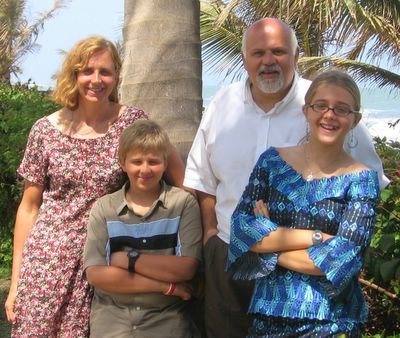
Monday, March 31, 2008

A Funny Thing Happened on the Way to the Women

Weather: Continued very hot and somewhat humid. Right now, my fingers are wrinkled from wiping the sweat off my brow in this internet cafe. Temps in the upper 90's, sometimes reaching 100F by early afternoon. Nighttime lows in the low 80sF. Nice afternoon breezes help out a bit, especially late afternoon, when we get the shade of our mango trees. Total rain since December1: around 2 inches.
-
For ten years, the MPCHS Women’s Health and Development (WHDP) program has worked with the women of a number of communities in Liberia’s interior. Grace Boiwu and her staff have supported and empowered the women of these communities by offering workshops on many topics, providing skills training so the women can help support their families, and even micro loans so that their budding businesses can expand a bit. The relationships by now are deep and look very much like friendship. The goal of WHDP has always been to heal and strengthen post-war communities by empowering women. But a funny thing happened on the journey. The women’s program discovered men.
The trip to Koon Town. A jarring two hour trek.

What I mean is WHDP is realizing that in order to more fully do its job to strengthen women, it cannot focus only on women and ignore the men of the community. Even if it remains primarily a “Women Health and Development Program,” it needs to figure out how to include men. Men are simply too important to the health of the community and the women, especially in this patriarchal society. In a way, this was inevitable. Take Koon Town for instance. WHDP has been in this little village for a decade, working exclusively with women, building skills, enhancing capacity, empowering them, transforming them-- while the men of the village watched from the sidelines. Yet the men are key stakeholders and of course have enormous interest in how

Koon Town, viewed from the road in. The arrow indicates my location in the next pic, looking back toward this point.

their wives, mothers and daughters are affected by all this empowerment and capacity building. Grace Boiwu and WHDP have come to a point where it seems obvious that it is time to include the men in this process. They see the connection between women’s empowerment and helping men become better men. They see women and men living in community need each other to be strong and healthy, in order for the community to be strong and healthy. What a concept.
Something tells me this is laundry day.

So last week, WHDP sent my Liberian co-facilitator, John Dominic Moore, and Yers Trooly up to Koon Town to begin the process of engaging them with a view toward their empowerment and building their capacity as well. John and I had a great time. Here we were, gathered with 21 Koon Town men, in the Women Empowerment Center—“built by women for women,” and discussing ways to make Koon Town a better place.

The men posing in front of our meeting place-- the Women Empowerment Center.

It felt like we were breaking some invisible barrier, like the time had come to work in a new way—women and men together—on community development.

The men were proud of this-- a cleared field, being prepared for cassava. Its a big field, and it is cleared without anything but the most basic hand tools-- in the hottest months of the year for harvest in the wet season. I almost died just walking the mile uphill (in the 100F heat of the day) it takes to get there. My bald head makes a great brain oven.

There are challenges ahead. One of the reasons WHDP came to be was to support women, most of whom were victims of violence because they are women. Gender Based Violence is still a problem in Koon Town. Wife abuse is still an all too prevalent part of the culture in this male dominated corner of the world. The fact that WHDP has empowered so many women has also, in some cases, created more conflict. The men feel their masculinity is threatened, their way of relating under attack. How can we help men see themselves in a new way, help them redefine their masculinity in a way that preserves their sense of “being a man,” and at the same time uplifts empowers the women in their lives? How to we teach these men what it means to be a man without sending the message that they’ve not been good at being men up to now?

The trip home. Following a truck laden with raw latex from the rubber trees.

The good news is, the guys seem eager to participate in the process. They seemed open and willing to engage us. They’ve seen what WHDP has done for "their women," and even though it has sometimes created conflict and left the men feeling powerless and out of the loop, they see it has produced impressive results. The women have learned skills, are more capable, have provided for the family. “Yes,” we imagine the men thinking, “they seem to be more assertive, and talk back when in the past they would have kept quiet, but maybe that is a good thing. Maybe if we figure out a better way to be together, we can figure out a better way to work together. And maybe together, we can make Koon Town a better place to live.” What we imagine, we can work to make happen.

I tried to get a shot with the shadows to give an idea of how bumpy these roads are. It didn't work. The roads may look flat. They are not.

Friday, March 28, 2008

Back Online (knock on wood)

Hey Folks,

Just a quick note. We are back online for the moment, so here are the shots of the playground. Hopefully, I'll be back on Monday with a story about Koon Town and "the women's program that discovered men."
Bob

Here is what the space looked like in early February.

Here is how it looks today.

Another view that gets the slides, jungle gym, merry-go-round, and swings.

Wednesday, March 26, 2008

Please forgive the lag!

Hi folks, Renita here, filling in for Bob, who is doing some work in a village called Koons Town, a few hours northeast of Monrovia.

It has not been easy getting online this week. Our goal is to post a blog entry at least once a week, and we aim for Monday, so for those of you who check in weekly, you may have wondered where we were. It turns out Monday was “Easter Monday” around here, a non official holiday where half the population plays hooky from work. The internet café we usually go to was closed. Then Tuesday the café was closed again, this time due to generator problems.

Just as a reminder, the internet situation in Liberia is that except for Monrovia, there really is no internet. In the city, one can get wireless receiver set up in home, but we live outside the wireless area. This means a three mile drive three times a week to the internet café where we send pre-composed emails, get email, and do any internet work we need to. The limited availability of the internet means are not on for more than a couple hours a week, and the kids are almost never on.

Anyway, Bob is gone today, and he’s the guy who’s in charge of the blog. So you’ll have to wait for the entry he was planning to post, but he asked me to at least write and tell you what’s going on with the lag.

I was planning on posting some before and after pictures of the playground that has recently been completed in Norm Katerberg's memory, but after going to three internet cafes and finding them all closed, and finally finding a fourth, I have tried to upload the pictures for the past 90 minutes only to have it fail again, and so I am going to stop trying. I am so thankful to Bob not only for his creativity and commitment to writing this blog every week, but also for the patience he has in working with the Internet in Liberia!

Monday, March 17, 2008

Liberian Cuisine, Part One

Let's talk about food. What we eat and how we eat it help define our culture, and I would be remiss if I did not explore with you Liberia's contribution to the culinary arts. Most of you know that the four Reeds spent much of our lives in the Great Lakes region of North America. Renita is Canadian, living most of her growing years in Ontario, while the rest of us are Michiganders through and through. We all grew up on foods very different from what we have encountered in West Africa. Compared with my midwestern culinary orientation, the food in Liberia is blunt, unrestrained, and powerful. Three years ago our uninitiated taste buds found many of the dishes overwhelming, and at times repulsive in flavor and texture. I remember thinking critically that there was no subtlety to Liberian cuisine, no "hinting" at this taste or "suggesting" that flavor - this was rude food. Little did I know that my perspective was based on a simple misunderstanding.

One of my pet theories about food is that when we reject a new dish or initially find it unpalatable, it is at least in part because we do not “understand” it. We don’t get what the dish is “trying to be,” so we don’t know how to orient ourselves to it. A similar phenomenon occurs when one is given a tuna sandwich when expecting an ice cream cone or when one is offered New York Cheddar on sourdough when one has his palate set for French Brie on a cream cracker. The offered food is rejected as unpalatable because the mouth was expecting something else. So it was for us with the cuisine of Liberia. Palm butter, bonies, foofoo, cassava leaf, red oil, fermented fish, bitterball, kitili, torpogee, fish heads, okra—many of the foods came with unfamiliar tastes and heretofore unacceptable textures. Some we found frankly disgusting. How could Liberians love this stuff? But that rhetorical question became the key to understanding. Liberians DO love it. Maybe we were missing something. So we kept eating, kept tasting. Gradually we began to figure these foods out, and as we did, we learned how to eat them,how to enjoy them and even look forward to them. We now have our favorites, and of course some tastes we still avoid, but mostly I think we can say that we finally understand Liberian food.

So beginning this week, I thought I’d present to you some of the foods we have figured out and learned to love—and maybe a couple that we still find confusing to the brain and disagreeable to the palate. Look for these every few weeks or months.

Before we get to the dishes, there are a few things you ought to know about Liberian cuisine. 1.) Rice is the staple of Liberia, with no close second. Rice is eaten with almost every meal. Most dishes are called “soup” and served over steamed rice. 2.) Most foods are boiled, roasted or fried over coals or a wood fire. You may use a stove top. 3.) Liberians use a lot of oil. Until we figured this out and redirected our Liberian cook, we were using a cup or more of oil a meal, mixed into the soup. Unfortunately, both the raw red oil and refined oil is palm oil, which is not generally considered to be very healthy. 4) Liberia being located where it is, fish is readily available, and is the most common animal flesh found in Liberian dishes. Dried fish is very popular here, in part because it requires no refrigeration. It has a very powerful flavor, which we tend to avoid. 5.) Hot Peppers are used in many dishes. Based on all of this, if you think of Liberian foods as spicy, fishy and oily over rice, you are getting the picture for much of it. Let us begin. Actually, because I’ve used so much space on this intro, we’ll only look at two dishes today.

Palm Butter
This could be called the national dish of Liberia. It is only recently that I figured this dish out, and now it is my favorite. Renita is learning to like it, but the kids still don’t understand it. Made from the flesh of palm nuts, it has a strong musky flavor.

To prepare: Wash palm nuts and boil until the skin becomes loose. Remove and place the nuts in a large mortar and pound until skin becomes separated from the kernels. Remove the kernels and continue beating skin, fibers and flesh into a pulp. Transfer pulp into a pan and add water, enough to cover. Wash pulp thoroughly, then squeeze liquid out of fibers and chaff. Pass liquid through a sieve to remove all fibers or traces of kernels. (Palm butter may be purchased already prepared.) Pour the liquid into a pot and continue to boil. Add a combination of preroasted fried or boiled meat, including chicken, crabs, dried fish, or dried meat - we prefer a combination of fresh beef (called cow meat) and fresh fish - along with 2 chopped onions, hot pepper to taste, seasoning salt to taste, etc. Let mixture cook until it becomes thick. Serve over rice, foofoo, or cassava.

Potato Greens

This spinach-like green also produces a sweet potato if allowed to grow but like the cassava both the leaves and the tuber is prized. The greens are also prized by Hannah who considers it one of her favorite dishes. We eat it every Thursday without fail. To prepare: Remove stems and wash 4 bunches of greens thoroughly. Cut—we prefer tear—into fine shreds. Combine with two cups chopped onions, and hot pepper and fry about 7-10 minutes, stirring constantly. Place into a pot with water. Add chicken or beef cube, salt, black pepper, seasoning salt to taste. Add pre-cooked meat—we prefer turkey—but anything (dried fish, fried fish, boiled pig’s feet, cooked cow meat) you like is acceptable. Boil away most but not all of the water. Serve over rice.

Monday, March 10, 2008

Around Foster Town

More overcast of late, but still little or no rain. Monday the 10th is began cloudy with a light westerly breeze. Overcast becomes hot, hazy and humid by afternoon, with highs in the low 90s and nighttime lows in the upper 70s.

The thing about containers—those large steel box-car sized crates shipped all over the world, stacked on top of giant freighters—is that they arrive when they arrive. And when they finally leave the port, you must be ready to cease all other activity in order to be there and unload what is yours. Receiving a container is like welcoming a dignitary or making a doctor’s appointment: whatever you were previously planning that day is instantly a lower priority; all other events are sacrificed for the sake of the stuff in the big steel box. Furthermore, when a container is late, as ours is now, each day is spent wondering, “is this the day we will need drop everything and rush into town to offload our things.”

Mostly the items on our particular container are books. Hundreds of boxes of books, collected and boxed mostly by Renita’s family working with Active Kids Canada, they are bound for five new school libraries around Monrovia. As with our other activities, we avoid simply handing out these books as if we are some scholastic Santa Claus. To receive these books, the schools had to actually build reading rooms, make reading tables and book shelves, and otherwise show investment in the effort. In addition, the library personnel must attend a two day workshop, sponsored by Active Kids, on setting up and running a library. We ran the workshops in our neighborhood Friday and Saturday, with a library person from the States doing her best to translate her very western style and manner to 40 very Liberian school teachers and librarians. It was a learning experience for everybody. To top it off, we of course had no books to distribute as we had planned. So we will need yet another day with the schools to give them their books when the container becomes available.

Also around Foster Town, the FACT board continues to meet and plan activities as well as run the Foster Town Market. With the new market superintendent, FACT is actually making some money for itself. The board is trying to figure out what to do with some members who are not pulling their weight. Laying down the law seems to come tough in this culture, which avoids conflict and is somewhat indirect in communication style.

We do have some tragic Foster Town news to report. Sunday, at the main road a couple hundred yards from our house, three men were killed when a taxi lost control while passing and ran them over as they waited by the side of the road. To add to the tragic circumstances, the car was filled with very young children—unaccompanied by any adult. The children were not hurt, but the taxi driver ran off, leaving the children at the scene. As of today no one seems to know whose children these are, or why they were alone in the taxi with this reckless young man. This makes about twelve people who have suffered accidental or violent death within a half mile of our house these past 30 months. Three have been shot, three killed yesterday, and the rest have drowned.


Somewhere in this stack of boxcar-size containers, our books await.

Our two day library training workshop-- Renita in the back with Renita on her lap.

The next day, we split the group. This is what the CFCA library looks like-- where o' where are the books?!?

Monday, March 03, 2008

ReedNews Update: March Edition

Weather: Monday the 3rd of March began with a cool westerly breeze, and drier air. The skies clouded up a bit by mid morning as the humidity rose, giving way to a hot haze by mid afternoon. We’ve seen a little rain during the past few weeks, but still averaging less than an inch a month since December. This morning the temperature was in the mid 70sF, and today’s highs will likely reach the low 90’s.

It is hard to believe February is behind us, but here we are three days into the third month. The LEAD conference is over, our guests are gone, and I'm back from my travels. Both Renita and I are catching our breath as well as lost sleep while finding full “to do” lists in front of us each day. At least its not crazy around here. LEAD is running three business/small loan classes as well as three micro credit programs in three counties. Total participants: 245. This keeps Renita traveling to and fro, and on those days she’s in Buchanan or Gbarnga, it’s a 12 hour day of travel, meetings and teaching. As for me, I have three projects running: teaching my class at MPCHS, designing a curriculum for a men’s program in Koon’s Town, and visiting Liberian national NGOs discussing possible future collaboration opportunities.

In other news:

Item- We can report significant improvement in road conditions to both Buchanan and Gbarnga, and not simply due to the dry season, which usually makes the impassable passable. The roads are patched and allow for less jolting rides for both human and vehicular suspension systems. The improved roads have also made travel time shorter, so we get back home faster.

Item- President Sirleaf has promised to visit the Foster Town Market, so everyone around our little corner of the world is anticipating the event. We’ll keep you posted.

Item- A container we have been waiting for has arrived and we’ll be sorting through its contents soon. Among the items are hundreds of boxes of books designated for five area schools. Working with a Canadian NGO called Active Kids, Renita has been liaising with the schools as they’ve each built (with help) a library-reading room in their respective facilities and soon those libraries will be filled with books. We will be conducting library science workshop next week to help the schools organize and run their new additions.

Item- The St Theresa School- Norm Katerberg playground is still under construction, but we hope to see a finished product by next week. We’ve had some snags along the way, and had to push the construction crews not to cut corners, but that is part of the norm here. I have no doubt the kids will appreciate the effort when done. We are putting in two slides, three swing sets, two merry-go-rounds, a jungle gym, and three teeter totters.

Item- Monrovia is out of eggs. As with tomatoes last fall, the city has run out of eggs. Not being an egg guy myself, I can live with it, but it is weird, especially since I thought the eggs were produced locally.

The road to/from Bong Mines in the dry season. Much nicer, but still a bracing experience.

On the way, a common sight throughout the country and continent-- wash day along a local river or pond.

Back around home, a young lady pounds cassava at the Foster Town Market.

Another common sight during our guest's visit-- Todd working on the car. This evening, he replaced the U joint.

Some of you have been asking, so here she is-- Renita Reeves, enjoying her first taste of solid food. We get to take care of her several days a week while mom tries to earn some money. A very easy babe.


Monday, February 25, 2008

Jes' Drippin'

Weather Hazy and hot, with very high humidity. Daytime temps in the low 90s, but nighttime lows no lower than the low 80s, making for very poor sleeping conditions, even with the fans. No breeze during the night, but it picks up in late morning and early afternoon. Rain since December 1: about 2 inches.

The air of late has been just about as sticky and heavy as any of us want to experience, but we proceed in the midst of dripping perspiration. The slightest physical exertion is all it takes to get a body drenched.

After a successful and encouraging trip to Senegal with my other CRWRC West Africa colleagues, I returned home to a broke Land Cruiser and a spouse with hands too full. Thanks to one of our visiting guests, Todd Flier, the Cruiser was repaired (U joint) that night in time for the big LEAD conference Saturday. The LEAD conference was successful, even though we hoped for about twice the 150 folks that showed. I think the people that showed got some great tips. The President had some very interesting things to say. She is a highly articulate and intelligent woman.

Today, the visiters are past the Bong Mines region, looking at an agricultural project. If the Bong County curse has been appeased, Renita will return home with tired guests in tow in about 12 hours.

The CRWRC meeting gave me a task, which I will write about later. Right now, I need to get back home and fill in on home schooling chores. Below are a few of the activities the guests have been enjoying. The playgound is coming along fine, but I'll wait until next week to give you that "After" picture.
Visitors Dick, Mary and Todd visit with Cecilia at the Foster Town Market. Examining peppers, okra and tiny eggplants.

A walk on the beach with Todd, Trokon (I think), a kid I don't know, Enoch, Dick and Knot.


The President of Liberia sharing nuggets of wisdom at the LEAD conference.
Sunday night, at the Samuel K. Doe Stadium-- a celebration marking the 150 birthday of Providence Baptist Church. From left, Lou Haveman of Partners Worlwide, Tokon, Enoch, Eastman, Todd Flier and Mary Dekker.

The stadium is as big and good as any in Africa. Severly damaged, it was one of the first things repaired (by the Chinese) after the 2003 war. It's a matter of priorities, you know.

Monday, February 18, 2008

ReedNews Update: Fat February Edition

We are in the midst of one of our most active months, and to add crazy to hectic, US President Bush will drive by our house and be in Monrovia next Thursday. This is only the second time a US president has "officially" visited Liberia, the other time when Jimmy Carter paid a call in 1978. (FDR stopped over at Robertsfield Airport during WW2, but this was only to visit US troops.) President Bush appears to have a heart for Liberia, and he and President Johnson-Sirleaf seem to have a great relationship. The February 21 visit will completely disrupt normal life in the Capital; roads will be closed all day, and we are hearing even the cell phone network will be de-activated. This apparently is to thwart possible attack by cell phone operated bombs. I do not understand this. How many nations would allow its entire cellular communication system to be disabled due to a visit from US president? Oh well, in other news:

Item: LEAD conference, titled “The Way Forward: The Future of Small Business in Liberia,” hopes to host 300 business owners at the all day event February 23rd. Speakers include members of the legislature, the head of the Liberia Business Association, the Minister of Commerce and President Johnson-Sirleaf. Pray that the turn out matches the quality of the event.

Item: The Nehemiah Liberia Group— the US partner to LEAD birthed out of our home church—Madison Square Church of Grand Rapids, Michigan—will have representatives visiting us, as well as other Madison Square folks this week. They arrive mid-week, will visit businesses and attend the conference, and do some other hands-on kind of activities, the leave next Wednesday.

Item: I get to miss the Bush visit—I’m in Dakar Senegal from Sunday the 17th until Friday the 22nd attending meetings with the CRWRC West Africa Ministry Team. There, other members of the team from Nigeria, Mali, Niger, Senegal, and Sierra Leone will be getting together. A big part of our agenda will be a day-long discussion of the future of CRWRC’s role in Liberia. That discussion is scheduled for Wednesday, the 20th.

Item: We are any day expecting a very late container to come, loaded with books donated by many loving Canadians—including Renita’s family and packed and shipped by Active Kids Canada. We now are hoping it will be even later, until after I return from Senegal to help with the hundreds of boxes of books.

Item: So we got books coming, but what do we do with them? No problem, we identified five schools with the capacity to maintain libraries, and Active Kids funded the actual construction of library rooms. The books will have homes, and five schools will have hundreds of books that had none before. Please God, let the container come after this week!

Item: Thanks to gifts that came to us in memory of Norm Katerberg, we have been able to sponsor a project we think would have delighted our dear friend. In Monrovia, there is a girl’s school with 851 girls, but no playground. Inspired by Norm’s boundless love of children, we decided—in consultation with the Katerberg family, to use the money for a playground. It will have two slides, three swing sets, two marry-go-rounds, three teeter totters, and a jungle gym. That gets built this week as well. Norm’s son, Todd Flier, will be out with the Nehemiah group to aid in the construction.

Item: My Conflict Analysis and Peacebuilding class started last week. It is a class made up of the last twelve students in the “Associates” program in Social Work. We are working to smoothly integrate them into the BSW program.

Item: The Land cruiser may be fixed, but it has cost several thousand dollars to do it. First the crankshaft was mistakenly “repaired,” then the fuel filter pump (very expensive item on this vehicle), then we needed rotors and brake pads. But we can now drive to Gbarnga without it breaking down, so maybe the sacrifice of US dollars appeased the Bong County powers.

Item: Nikki is not pregnant.

Here are a few pics-- sorry about the small captions. Its a long story. The bottom two are of Monrovia, one looking from the north at the city, the other, same location, looking to the north at an area called West Point and the port beyond. The arrow identifies the Mercy Ship.


Monday, February 11, 2008

The Continuing Saga of Enoch the Indomitable

He’s now ten, and not much taller than when we introduced you to him twenty months ago. (See May 2006 Archives). Enoch continues to be part of our lives, although the boundaries of our relationship have changed—literally.

About a year ago or so ago, just as Noah’s friendship with Trokon and Eastman blossomed, we began to have problems with Enoch. It seemed whenever Enoch and Trokon were in the same area with Noah, the two Liberian boys were at it, picking fights, harassing and generally “causing palaver” with each other. Because Noah was not actually friendly with Enoch, we began to invite the young lad into our yard less. This did not quiet Enoch down much, in fact I think it just revved him up. He continued to harass and tease Trokon, Noah and Hannah whenever they ventured out of the yard. Sometimes I needed to get involved, and sometimes Enoch actually listened to me. It has always been the case that I have held a special fondness for him, in spite of (or maybe in part because of) his incredible ability to read people so well and instinctively drive them up a wall. His uncommonly quick wit (and tongue), his resilience in the face of adversity, and his non-stop mischievousness are for some reason irresistible to me.

In time, Enoch alienated enough of us to the point where he was almost never invited into the yard, although I continued to maintain a relationship with him, occasionally taking him with me on errands, leaving food for him, buying him footwear, and giving first aid. About six months ago, Enoch, who never met a temptation he could resist, began stealing Legos and other toys from Noah on those rare forays into our yard. Eventually, after trying short term banishments, I told Enoch he was simply not going to be allowed in our yard at all unless I was there to personally monitor him. So for a couple months, we did not see him. I missed him, but at least it was more peaceful around the neighborhood.

About a month ago, in an ironic turn of events, Enoch and his old nemesis Trokon started to hang out together. Because we see Trokon daily, he brought Enoch back into our world—only this time, when Trokon came over for his after-school-til-dark visit, Enoch could only come as far as our gate. Undeterred, he promptly climbed a mango tree just on the other side of our wall and perched himself there. Then he got active—relentlessly calling out to the boys playing on the porch, calling out to me, or Renita, or Hannah-- hoping for any response. I knew I couldn’t stop him, so I began chatting with him up there from the yard. It seemed to give him something he needed. His visits are now almost daily. Somedays, he is up in that tree for hours, entertaining himself with singing, carrying on conversations—sometimes just with himself-- and laughing.

In the evenings, when we go out and sit in the yard, he takes part in the conversation from his mango tree perch. At dinner, Trokon takes some food out beyond the gate to share with him. When he has first aid needs, he comes into the yard for treatment—not as far as the porch though—and then goes back out. I still pick him up on the way to do errands, and I drop him off at the tree when we return. Little rogue that he sometimes is, I still find it impossible not to admire him. He has adapted to the boundaries—a nine foot cement block wall and razor wired steel gate—as casually as if it was a decorative white picket fence. I guess adapting is what he does best. As always, he gets as close as he can, and with that wit and humor and voice, still gets us all going from his perch on the other side of the barrier. And at the end of the day, when darkness falls and the boys go home and we head into the house, I sometimes pause and find myself looking over the yard. I know it is good that we have the wall. But lately, I'm thanking God for that mango tree.


Outside our wall, Enoch (back to us) hassles the boys whipping the grass, so Eastman goes toe to toe with him.
On another afternoon, Noah and Trokon escort the lad from harm's way.
At days end, with Renita in hammock, and I in the chair, the boy in the tree never lets us feel lonely.
Some days, we engage in heated debates regarding the dietary value of palm butter.
For medical treatment, he is allowed in the yard. Here Trokon prepares to remove what Liberians call "Jiggers" from the lad's toes. The animal burrow into the skin and lay eggs which grow and do damage. Trokon is and experienced Jigger remover...

...but its not pleasant. This day, Enoch had over ten jiggers in his feet. He screamed and cried as Trokon went to work, with Eastman observing.
Its probably good the foot is a bit blurry. Here is what it looks like post-op. I put some anti bacterial stuff on it and bandaged it, but by the next week, more jiggers had climbed into the wounds. With Enoch, self care is all about the next meal, never about avoiding jiggers. Maybe he'll remember the tears.

The other day, just outside our wall, he was playing in a brush fire. Not good, as they can get out of hand even with adult supervision...
... So I put him to work on a "Reed Road" project with Trokon as supervising contractor.
Farwell from up in a tree, over the wall, though the razor wire and across the waves.


Monday, February 04, 2008

LEADing the Market Women

Weather: After a week of very nice conditions, the heat is back on. Harmattan returned for a week, and we saw cool morning temps—the coolest, actually, in the 30 months since we’ve been here. One morning it got down to a record 60F (15C). Once again, however, morning temps are in the low 80s with high humidity. My glasses actually fogged up this morning just sitting on the porch. Daytime highs in the 90sF. Steady, light ocean breeze, and not a drop o’ rain since early December.

February promises to be one of those months where we just hold our breath and rush to the end. Both Renita and I are juggling activities. I’m teaching a conflict transformation and peacebuilding class for the Mother Patern social work students beginning on the 11th, and on the 17th I’ll traveling to Dakar, Senegal for a week of meetings with the CRWRC West Africa Ministry Team. The agenda includes discussing the future of CRWRC’s work in Liberia, and also next steps for the Reeds. Renita has her hands full as LEAD prepares a business class in Monrovia, Buchanan and the new branch in Gbarnga while at the same times gets ready for a LEAD conference on the 23rd—which, I’m happy to report, will feature a keynote address by none other than Liberia’s President, Ellen Johnson Sirleaf. Add to that an upcoming weeklong visit by representatives from our home church, and we find ourselves with overflowing plates.

If that wasn’t enough for her, today Renita is right here with the LEAD team in Foster Town. The women of the FACT Community Market are among the first to participate in LEADs brand new empowerment initiative for microbusinesses. Until now LEAD has been targeting midsized businesses that could conceivably grow and employ more people. LEAD will continue to serve midsized businesses with loans and business education, but this new initiative will assist very small businesses, like those run by the women at the market. So today and tomorrow (Monday and Tuesday) the women will receive a 15 hour business skills seminar, and after saving for two weeks will receive a US$100 microloan to invest into their efforts. If these loans are repaid, the women can apply for larger loans and perhaps eventually apply to be part of LEAD’s midsized business initiative.

It is not only exciting, but satisfying to see this LEAD/FACT partnership come about. We know these women—they are our neighbors. The market was built by members of this community through FACT, the new community development group working collaboratively with friends from North America. Likewise, LEAD is a product our efforts, along with our partners and friends. LEAD has “come home” to join FACT in serving our very own neighbors. It is as if two of our children, after going out and doing good things on their own, have for the first time found reason to join forces and for a time do their good work together. It makes a parent proud.

Next week: The Continuing Saga of Enoch the Indomitable.

First, proof of coolness in Liberia.

The women of the FACT market listening to James Hilary-- LEAD's veteran. He's been with LEAD almost from the beginning.


Renita, looking serene and contemplative at the same workshop, shares pearls of wisdom gleened from living with Yers Trooly lo' these many years.

And finally, who is this kid spending hours in the mango tree peering into our yard and singing day after day? Give ya a hint... tune in next week.

Monday, January 28, 2008

The Bong County Curse

Weather: Hot and dusty during the day with highs in the mid 90s. Pleasant on the porch by morning, with temps in the low 70s—sometimes the high 60s. No rain.

Ok, maybe I overstate. But since we have had the Land Cruiser, every time it travels northeast to Bong County, something goes wrong. We've traveled south, to Buchanan in Bassa County several times over terrible roads, with no problem. Not so with Bong. The first time we took it to Bong Mines, it got stuck and sustained body damage. The second time, it lost a fan belt coming back from Ganta and it took three hours on the roadside to get it back running. (I know what you are thinking--Ganta is in Nimba County, so it can't be the Curse. But it wasn’t until we crossed the county line into Bong that we had the problem. Need I say more? But I shall.) The third time we were on the way back from the Bong County seat of Gbarnga when a timing belt went, but we limped home and fixed it next day. Thursday, Renita took it to Gbarnga and we thought she broke the curse by arriving home safely. We breathed easy when she pulled in the yard. Next morning, I got about two miles in toward town when it died on me. After getting it off the road and waiting six hours for the Mother Patern mechanic Mohammed to arrive, he gave us an ominous initial evaluation. It sounded like something in the engine block—perhaps a piston or something else. The Bong Curse had returned with a vengeance.

Anyway, that was three days ago. We still have no Cruiser and do not know when it will be fixed or how much it will cost. We still have the ’95 Pathfinder, although it is definitely showing its age in this climate. We believe the Pathfinder is also affected by the Bong Curse, even though it’s in no condition to get anywhere near Bong County. We used it to push the Cruiser off the road and it doing so, we broke the plastic hood wind screen thingy. We’ll keep ya’ll apprised.

Renita and Noah are both sick—Renita is coming off Pink Eye and now seems to have strep throat, while Noah has had a steady, spiking fever for four days along with diarrhea. They’re both miserable. I, on the other hand, remain chipper as ever.


If the hood is up, this must be Bong County.

Tuesday, January 22, 2008

Tid Bits

Weather: A few days last week were very hot and humid, with temps nearing 100F (38C). The weekend saw moderate temps (highs in the low 90s, lows in the upper 70s) and steady 15mph sea breezes. Monday sunny, with temps in the mid nineties, very light breeze, and moderate humidity. No rain.

Big news from Grand Rapids comes to us from Cheryl Brandsen, chair of the Calvin College Social Work department. Our collaboration team from Calvin and Kuyper Colleges in Grand Rapids and Mother Patern College in Monrovia has been holding our breath for six months, waiting for word on a grant proposal to fund the BSW project. We can breathe now--The grant was approved for us to shift into high gear. The team, including faculty from both US colleges, hope to be on the ground this summer to continue prep work for their teaching visit next January. This also means textbooks!

Our brother-in-law Brian is back with us, here to do some work with LifeWater Canada. He’s gone most of the day, working in the sun on a new operations compound for LWC’s national counterpart LifeWater Liberia. It was LifeWater Liberia that provided the five new wells for Foster Town.

Noah Reed is now a teenager. On the 16th, we celebrated the lad’s 13th birthday with a medevial murder mystery. We invited the usual suspects in for a dinner party, in which everyone played a part. Not everybody quite got the concept, but it was great fun. Birthday boy Noah was the murdering jester, with Mom in a supporting role as the Hag, Uncle Brian as the guard (“Brioon of Lorna Doone”), and Yers Trooly got to dress in drag and play Nurse Roberta. We played host to Kings, Queens, a Princess, a prince and a Duke. In the end, the troop failed to discover “who done it,” so Brioon executed the wrong guy.

The Foster Town Market is doing well. The new market superintendant has submitted a budget, is cracking down on inefficiency and some in-house corruption, and for the first time the market is actually making money for its parent-- the Foster Town Association for Community Transformation (FACT).

The palm civet continues to enjoy human company. In addition to bananas, she loves roaches, crickets and all manner of bugs. I went to take a nap the other day and he was in my pillow. Almost squished that little lady before I realized where she was. We’ve been meaning to get a cat for a while to play host to our frequent mouse and rat guests, so last week we got a kitten to also provide company for Houdini. The cat is named Pebbles, after our long deceased Michigan puss named Rocky. After a couple days of wary adjustment, cat and civet are now playmates.


Monday, January 14, 2008

On Being Grease

Weather: Harmattan visited us for less than a week, with morning temps as low as 64F, a relatively low humidities. We were caressed with perfect weather for about four heavenly days. Alas, all that is over. Temps and dew points are back up with highs in the mid 90s and humid, and outside morning lows are back in the 70s. Morning lows in our house, low 80s.

It is not unusual for Renita or me to get inquiries regarding our work in Liberia. Every week, a curious web surfer stumbles across our blog and contacts us with questions. It is familiar, and really, everybody gets these “So tell me more about your work” requests. Usually, after receiving the information, they say something nice about us and go on with their business. Every once and a while though, we get something like this, “What difference do you think you are making in people’s lives?”

It’s a good question.

To be perfectly candid, I wonder sometimes what difference we make. Not about everything, like I know helping build the Foster Town Market directly impacts a lot of people, but some things I wonder about. For instance, I wonder about the many workshops that Renita and I do. We average a couple hundred hours of workshops every year. We speak before Liberians in rural settings and in schools, in churches and in palaver huts. We discuss topics ranging from “how to manage your microbusiness,” to “resolving conflict in your village” to “Christian leadership.” Is it reasonable to think most of the participants—or even a few—will be changed by what we offer? After spending a few hours together, is it reasonable to expect what we say will even be remembered? Are we wasting our breath if few remember?

Last Friday I sat in the conference room at the Ministry of Health and Social Welfare. There were a few of us from various organizations and from the Ministry. We were discussing the fact that mental health is low on the government budget priorities. For the umpteenth time. It seems that as the country emerges from its devastation, focus remains on the most serious, most visible damage: roads, infrastructure, and in the health arena, on medical conditions like malaria and HIV. Mental health is difficult to address, or maybe to even think about. So for two and a half years, I’ve faithfully attended most of the Ministry’s “Mental Health Task Force” meetings. I may have attended more meetings than anyone. I’ve offered input, helped with studies, written reports, and conducted a national reporting workshop. And there I was Friday, after two and a half years, listening to some new Ministry guy telling us how important our voice is, that we must continue our advocacy of mental health programming, that the country cannot recover without it.

Blah blah blah.

I thought, “Who are we kidding? Nobody has listened to our advocacy yet, what makes us think anybody will start now? The country is not ready to address its huge mental health needs. We are not making any difference.” I decided I would speak up and say just that. So, in a lull in the conversation, I started to speak. The acting chair person’s phone rang (and in Liberia, phones are almost always allowed to interrupt whatever is going on.). I waited. After the call, we got diverted. Another lull came. I started to speak. The conference door opened, and a latecomer arrived and had to be brought up to speed. Then another diversion. Then another lull, and for the third time I started to speak, only to be interrupted again. I realized that maybe Somebody wanted me to keep my cynical mouth shut. I realized I was being told to take a step back.

I took a step back in my mind, and with a new inner perspective came a new thought. Maybe we are just one part of a process. Maybe we are supposed to be advocating regardless of who's listening, giving workshops that may be forgotten, supposed to be banging our heads against the wall. After all, if you bang your head long enough, the wall gives way. Maybe someday the country will be ready for prioritizing mental health, and then they just might listen to our advocacy, even if we are long gone.

Then in my mind I took another step back, and it hit me that whatever we do, whether we see immediate results—like building a market—or nothing at all, we are everywhere part of a process, like cogs in a giant machine. Or not like cogs, because we are not that important. Maybe we are like grease helping cogs run well. We do our part, get used up, get replaced, but in time our sacrifice, and the sacrifice of those before and after us, pays off. In the end, only the Master Machinist knows the how and where we changed things for the better. I guess in the end, it doesn’t necessarily matter that we see what difference our being used made. In the end, I think it matters mostly that we can say we were available for use and got used doing what we were made to do.

The difference comes in being available.


A couple available people in our lives. Trokon, here 2o feet up trimming the lower branches of one of our two coconut trees. The 12 year old climbs without a ladder and wields the cutlass like a pro. Insert shows him up close in the tree.

Sis' Vera-- available to us every weekday, making shopping, laundry and cooking much easier for the Reeds in Liberia.

Monday, January 07, 2008

ReedNews Update: January Edition

Weather: Hot in the days, cooler at night, with daytime highs in the low 90Fs (33C) every day and lows as low as the upper 60Fs (19C) by dawn. Light ocean breeze throughout the day. Virtually no rain since December 1.

Harmattan is returning as I write and promises to give us a couple weeks of cool dry breezes, which makes this the most pleasant season of the year for me. We've been sweltering in hot temps and moderate humidity.


The most humid time is May but dew points have still been high enough to produce lots of sweat and tee shirt changes. I've been going through about four a day. This is a dusty time, with virtually no rain from December to April. We have had a couple cooler nights—got down to about 79F in the house. Very nice relief from the norm. We are just coming off Christmas break which means back to work for Hannah, Noah and Yers Trooly, and simply turning up the volume for Renita. Here’s more news.

Item: Former president Charles Taylor's trial in the Hague for war crimes and crimes against humanity has begun after a six month delay. There are supposed to be many eyewitness to his actions. Keep up with the developments on the BBC.


Item: Road work is happening in lots of places, with resurfacing and patching being the primary activity. So far we’ve seen no signs of widening any roads. They really need to rebuild the shoulders at least, because it is not uncommon at all for there to be a foot or more drop on either side of the road. Traffic is fairly jammed during rush hours, but it clears up during the day and on weekends. The government just received a bunch of buses from Spain that they say they are going to use for public transportation.

Item: The cost of living is exploding with food and gas prices leading the increase. As the economy improves, merchants see an opportunity to boost profits. Everyone, from Lebanese building supply owner to Liberian microbusiness operator is asking more for their product. For us it has meant a 20% increase in operating costs this year, with most of that in the last quarter of ‘07. In addition, the value of the Liberian dollar is showing signs of weakening.

Item: Renita continues her LEAD collaboration with the World Food Programme while also interviewing candidates for the new LEAD office in Gbarnga. She is also preparing for a LEAD-sponsored conference on the future of small businesses in Liberia. More on this later.

Item: I’m working on a joint project with the International Rescue Committee (IRC) and the MPCHS Women’s development program on a series of workshops in the village of Koons Town. Ironically and appropriately, the women’s program is targeting the men of the village as it tries to reduce Gender Based Violence (GBV). More on this later. I’m also getting ready to teach a course in Conflict Analysis and Peacebuilding for the MPCHS social work students.

Item: Without getting graphic, Max and Niki are behaving rather “amorously” toward one another this week. Very touching. I don’t want to get anybody’s hopes up, but we will be listening for the patter of little paws sometime in early March.

Item: Trokon’s mother, who lives in the interior, brought us a creature from her neck of the rainforest. It is an African palm civet (Nandinia binotata). I actually ate one a couple years back in Cestus City with cassava leaf over rice. Kinda chewy. Most Liberians call it a “Tree Coon.” These creatures are not in the same family or genus as most civets, and are sometimes confused with another civet of the same name. Common creatures, they are not threatened, and do quite well in captivity. So we’ll keep her a while. Reminds me of a cross between a house cat, a raccoon and a teddy bear. Omnivorous, she loves bananas and crickets. Noah named her Houdini.


Look at this lil' lady! No, she's not getting squished, just held with authority. Note the pink feet.
She eats a banana a day. Finding a warm shoulder to rest upon.
A non-civet related shot of the kids. This was actually last Halloween. They banged on our bedroom door demanding candy.

Monday, December 31, 2007

Looking Back, Looking Forward

Weather: Hot and Humid. Daytime temps in the mid 90s, lows in the mid 70s. Light variable breezes. No precipitation. Less than one tenth of an inch of rain since December 1.

So 2007 is history, and 2008 is upon us. The year promises to be eventful for this country in transition. Year end is the right time to look over our shoulders at what has been accomplished through the efforts of a few of us . We know what we’ve done is small for this nation of three million, but there are thousands joining in to rebuild Liberia. So we feel good about that small part we’ve played. For those who might wonder what we were up to on ’07, here is a partial list.

  • Helped develop and launch the first academic program to train professional social workers to support individuals, families and communities get back on track in a postwar environment through the Mother Patern College of Health Sciences. 25 first year students.
  • Saw LEAD Inc. expand to two more counties; Liberian staff increased from one to seven. Trained more LEAD businesses, bringing the total to 233 businesses with 71 business loans.
  • Working with the fledgling Foster Town Association for Community Transformation (FACT) we constructed a major community market place where a hundred women can come and sell food, clothing, and other products-- plus have a central place to simply connect.
  • Conducted many workshops, developed and taught another college course.
  • Made important recommendations to the Liberian Government and key players regarding mental health training standards; developed and presented a related national workshop.
  • Continued our partner relationship between Calvin College, Kuyper College and Mother Patern College of Health Sciences.
  • Provided 22 school children with full tuition scholarships for the entire year through your gifts to our community fund.
  • Underwrote eight Foster Town business start-ups (apart from LEAD) through your gifts to our community fund.
  • Facilitated new partnerships between
    o LEAD and the World Food Program to work with women who are HIV/AIDS positive in creating self-sustainability through business.
    o LEAD and the International Labour Organization for the creation of 40 new trash removal businesses, a much needed utility in Monrovia.
    o Active Kids Canada and five Liberian schools for building libraries, and the shipment of thousands of textbooks and reading books—arriving January 2008.
    o LifeWater and FACT for the construction of four new wells in the Foster Town area.

So it’s been a good year. What does 2008 look like? Well, we will continue our work with LEAD, Mother Patern College, and the Foster Town community. Our volunteer agreement with CRWRC ServiceLink ends June 2008, although we’d like to continue at least into the fall. We have not the first clue as to what follows our work in this country, but since our hands are full while we are here, I guess we’ll find out when we are supposed to about life after Liberia. When we know, you’ll know.

Until then, stay tuned, hang on, enjoy the ride—and have a HAPPY NEW YEAR!

Note: internet is acting up, so no pictures. Next week, we’ll introduce you to another of Liberia’s indigenous creatures: the Two Spotted African Palm Civet! She’s a real sweetheart.

Monday, December 24, 2007

MERRY CHRiSTMAS!!


In this season of Advent, anticipation, and delight

In this season of hurry, jostling, and anxiety

In this season of remembering--

With tears of sadness and joy

In this season of hope;

The Reeds wish you, our many friends,

* near and far away *

All the warmth and goodness of this most special day.


Bob, Renita, Hannah & Noah